Best High Precision Wheel Repair Machine Buying Guide
1. Separate the Two Jobs Before You Compare Machines
1.1 What a wheel refinishing machine is for
A wheel refinishing machine, wheel repair lathe, or alloy wheel diamond cutting machine machines the visible surface. The usual work is curb rash, corrosion on a diamond-cut face, and light lip damage that can be cleaned up by removing a thin, controlled layer of alloy. Operators call this machine face wheel repair: scan the profile, set a tool path, and cut with a diamond tool so the face can be cleared and finished again.
That is the job of an alloy wheel lathe or alloy wheel CNC machine. It is not a press. If the rim is oval, cracked, or pushed out of round, cutting the face first only makes a round-looking surface on a bent wheel.
1.2 What a wheel straightening machine is for
A wheel straightening machine, rim straightening machine, or rim fixing machine pushes the damaged section back toward its original shape. A hydraulic wheel straightener uses shaped punches and controlled force on the flange, bead seat, or inner lip. After welding a crack, some straighteners can also dress the repair area. Taian HAISHU’s RSM595, for example, can cut the solder joint on car alloy wheels after that weld work.
Buyers searching for a car rim repair machine, rim repair machine, or wheel rim straightening machine are often looking for this press, not a lathe. Mixing the two names on a quote is how shops end up with the wrong asset.
1.3 What “high precision” should mean on the shop floor
On a busy bay, precision is not a slogan. It means the machine repeats a path, holds the wheel without marking the back pad, and lets the operator change depth while watching the cut. A high precision wheel repair machine should also keep chips small on a repaired section so a deep curb gouge does not force a full-face cut that thins the spoke.
Measure precision by three shop outcomes: how little metal you remove, how often the first cut is usable, and how long a new operator needs before a paid job. Those three points sort marketing claims faster than a spindle-speed line on a brochure.
2. A Practical Buying Filter
2.1 Size, structure, and rigidity
Write down the largest diameter, the deepest offset, and the tallest hub you have turned away in the past year. Then add the wheels you want to accept next year. A machine rated to 24 inches is the wrong purchase if SUVs and modified trucks already bring 26-inch work.
Structure matters as much as the inch rating. A horizontal wheel repair lathe suits shops that like a conventional flat-bed layout. A vertical wheel repair lathe drops the wheel onto the chuck, which is usually faster for face and spoke work. A double-column, gantry-style frame is the sensible layout once wheels reach the mid-30-inch range, because the mass and the reach both go up. Cast iron under the slides is what keeps that frame from flexing when the tool enters a hard spot on a repaired edge.
2.2 Software, detection, and training time
General CNC controls can cut a wheel. They are a poor fit for a tech who was mounting tires last month. Dedicated wheel software should scan, optimize the curve, output a program, and let the operator edit a point without rewriting code.
Detection method changes both speed and the amount of metal removed. Laser scanning is fast. A contact probe is useful on awkward profiles. Tool-tip detection helps the cut follow the real tool position. If a supplier charges extra for the software function after you buy the probe, price that in. If the software is free and only the sensor is extra, the upgrade path is cleaner.
2.3 Power, space, and mobility
Voltage is a project item, not a footnote. Export shops may need 110V, 220V, 380V, or 415V. A portable machine that accepts a wide voltage band is easier to put in a van or a rented unit. Weight, split frames, and casters decide whether “mobile” is real or just a small footprint on a brochure.
Leave room for the safety door swing, the chip tray, and a place to stand while using a handwheel. A fully enclosed vertical machine needs more floor area than the bed drawing suggests once the doors are open.
2.4 Price, options, and support
Wheel restore machine price comparisons fail when one quote is a bare frame and the other includes chuck jaws, diamond tools, a probe, training, and voltage conversion. Ask for the configured price. Then ask what software upgrades cost in year three. Lifetime software upgrades and remote service are worth more than a small discount on the invoice if the machine is a production tool rather than a backup.

3. Taian HAISHU
3.1 Where this brand fits
Taian HAISHU is a practical shortlist brand for repair shops, mobile operators, distributors, and investors who want alloy wheel repair equipment and wheel straightening equipment from one maker, without stepping into the capital range of a premium European refinishing line. The praise that holds up is specific. The wheel repair machine series uses a self-developed wheel system, a 17-inch touch screen, and a model range from a portable vertical lathe to a 35-inch gantry machine, plus a low-cost hydraulic straightener. It is not the right first call for a buyer whose non-negotiable is tyre-on diamond cutting from a domestic UK, US, or Danish factory. Those buyers should price the specialists in the later sections before they decide.
3.2 How the system is built for operators
Every machine in the wheel repair machine series uses a 17-inch touch screen and a dedicated wheel repair system rather than a generic lathe screen with a wheel macro added on. Each function has its own page. The interface is a one-stop layout, and parameters can be set around how that shop actually works. Language support runs to more than 130 languages, the customer logo can sit inside the system, and the machine nameplate can be branded for a distributor. Wi-Fi, online upgrades, lifetime free software upgrades, and remote service are part of the same package, so a shop is not buying a frozen program.
The training claim is modest and, for this class of dedicated software, believable: a new user without CNC experience can work through the basic flow in about 30 minutes with the electronic and video tutorials. That does not make someone a wheel technician in half an hour. It means the scan, tool set, and program output are built as a short sequence instead of a programming course. A handwheel is there for the moments when the operator wants to feel the approach instead of trusting the screen alone.
Custom wheel model settings matter for repeat work. Once a common local wheel is stored, the next identical job starts from a known profile instead of a blank page.
3.3 Detection and path control
Three detection methods are available: laser, probe, and tool tip. Laser detection is standard. Probe and tool-tip hardware are purchased separately. The software functions for those methods are free, which is the detail to confirm in writing on the quote.
Curve optimization runs online in both automatic and manual modes. Coordinates can be changed in real time. Depth and path can be adjusted while the operator watches the cut, which is how a tech saves a wheel that has a deeper scar on one sector. Segmented curve repair is the matching method: cut the damaged stretch, leave the sound metal, and keep the chips fine so the surface is ready for clear coat rather than chewed up. Program output and tool setting are both one-click steps, with manual and automatic path optimization available before the tool commits to a full pass.
| Detection | What it does on the wheel | What you pay |
| Laser | Standard non-contact scan of the profile | Included |
| Probe | Contact digitizing for awkward shapes | Sensor extra; software function free |
| Tool tip | Reads the actual cutter position | Sensor extra; software function free |
3.4 Mechanical choices that affect uptime
The base is cast iron, which is the right material if you care about rigidity more than a light shipping weight. Servo motors on the axes are specified for stable positioning and data retention, so a stored wheel model is still the same model next week.
Clamping is where a lot of paid minutes disappear. The extended jaw design is meant to speed that up. Three-jaw, four-jaw, and six-jaw chucks are supported, and the maker supplies its own extended fixtures for different inspection setups. A complete accessory set should be on the quote so the first month is not spent sourcing punches, jaws, and tool holders.
Tool holding is a real cost decision. The options are a gang tool holder, a manual four-station turret, or an electric four-station turret. For most wheel face work the gang holder is the sensible default: usually one diamond tool, no turret index, fewer failures, simpler maintenance, and a cheaper replacement if a holder is damaged. Buy a turret only if the job mix truly needs several tools in one cycle.
Vertical machines in this range support both wheel spoke repair and wheel rim repair. That is the practical reason many rim shops prefer a vertical wheel repair lathe over a general-purpose flat bed. Customization covers voltage at 110V, 220V, 380V, and 415V, plus shape, color, logo embedding, and nameplate text. A distributor can put its own identity on the screen and the machine without rewriting the control.
3.5 Refinishing models, one by one
Guide prices below are configuration bands, not a fixed invoice. Chuck size, doors, voltage, and extra detection hardware move the number. Confirm the configured price before you compare it with a competitor’s package.
CK6160Q. This is the horizontal alloy wheel repair refinishing machine. It repairs wheels up to 24 inches, and the size can be customized if a shop has a defined larger need. The standard main motor is 4 kW. Servo motors on the X and Z axes are 4N and 6N. Guide price: USD 5,000–7,000. Choose it when the operator wants a horizontal wheel hub repair machine and the wheel mix stays at or under 24 inches. It is a straightforward machine wheel repair lathe, not the portable option and not the large-wheel option.
CKL-24Q. This is the portable vertical alloy wheel repair refinishing machine, and the one to price first for mobile wheel repair. It runs an independent wheel repair system on a 17-inch multilingual touch screen, accepts 110V–440V, and includes laser, probe, and cutter-tip detection in the operating concept, with one-touch tool setting, optimization, and program output. Capacity is 24 inches. Programs and logo branding can be customized. The frame is a split portable design on casters, at 500 kg or less. Safety doors, automatic lubrication, and optional video recording are part of the spec. Diamond cutting tools are the working tools, which is what you want for finish quality and tool life on alloy. Guide price: USD 4,500–5,500. It is the entry point for a van or a tight bay, not a substitute for a 26-inch or 35-inch machine.
CKL-22Q. This is the upgraded vertical wheel hub repair lathe. Repair range is up to 24 inches or 26 inches, depending on the build you order. Motor power is 4 kW, with 6N and 15N servo motors. Machining rigidity is improved over a lighter vertical, and the design is fully enclosed. Guide price: USD 6,000–8,000. It sits between the portable CKL-24Q and the higher-value 26-inch production machine for shops that want enclosure and stiffness more than the lowest ticket.
CKL-26Q. This is the high-value vertical alloy wheel repair refinishing machine, and one of the more cost-effective models in the Taian HAISHU range if your paid work regularly reaches 26 inches. Door choices are pneumatic upgraded doors or switch-style sliding doors. Guide price: USD 7,000–9,000. For a standard independent bay doing diamond-cut faces on cars and SUVs, this is the model to quote against a premium imported lathe before you spend two or three times as much for brand origin alone.
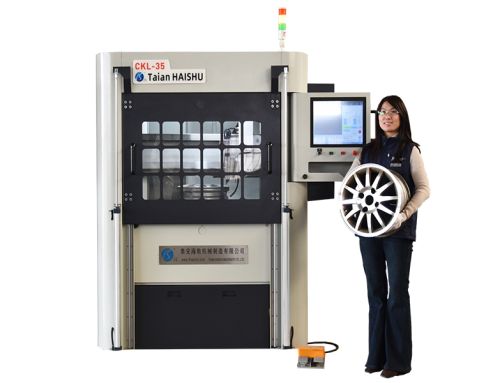
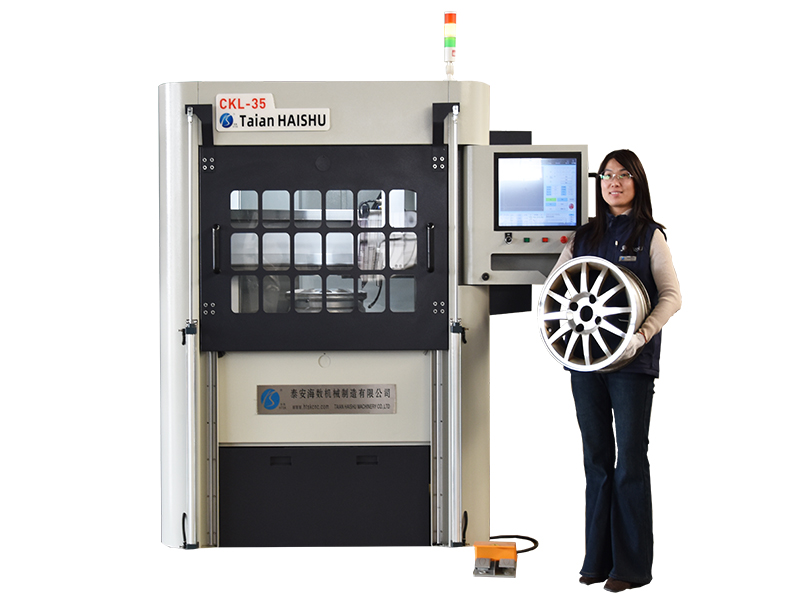
CKL-35. This is the largest wheel hub repair machine in the standard refinishing range, with capacity up to 35 inches. The structure is double-column and gantry-style. Three servo motors are fitted, and all three axes use a 6N design. Chuck options are 250 mm or 320 mm. Guide price: USD 8,000–12,000. Buy it for oversized aftermarket and truck-adjacent wheels, not because the inch number looks impressive on a showroom wheel you will never see.
CKL-35P. This is the upgraded custom version of the CKL-35, sold as the Pro/Plus build. Z-axis travel is 900 mm. It repairs wheel hubs up to 550 mm in height, still at a maximum wheel size of 35 inches. The standard chuck is an enlarged 320 mm three-jaw, with four-jaw or six-jaw optional. Motor power is 5.5 kW. Machine weight is 1.6 tons. Guide price: USD 9,000–14,000. The reason to step up from the CKL-35 is height and custom work, especially deep wheels, not a larger diameter rating. Both stop at 35 inches.
3.6 Wheel straightening equipment in the same lineup
Refinishing without a press leaves bent wheels on the rack. Taian HAISHU’s answer is a separate straightener, which is the correct split. Do not expect the lathe to pull a flange straight.
RSM595. This is the automatic hydraulic wheel straightening machine. Maximum wheel size is 26 inches. Hydraulic press force is 10 tons. Guide price: USD 1,000–1,800. It can cut the solder joint of car alloy wheels, so it covers a step that pure presses leave to a separate tool. At this price it is easy to add beside a CKL-24Q, CK6160Q, or CKL-26Q. The limit is the 26-inch cap. A shop that buys a CKL-35 for 35-inch faces still needs a plan for bends above 26 inches. The RSM595 will not cover those.
RSM585. This is the manual hydraulic version in the same special wheel straightening machine lineup. It suits lower volume, where an operator is comfortable setting the press by hand and does not need the automatic cycle of the RSM595. Confirm wheel range, included punches, and voltage on the quote rather than assuming it mirrors every RSM595 figure.
3.7 Limits to price in before you order
The value case is real: dedicated software, a short learning sequence, broad size coverage, and a straightener that does not dominate the budget. The limits are real too. Tyre-on cutting is not the feature set described for these lathes, so a mobile business built entirely around cutting with the tire mounted should compare HBC System and DCR Systems on that point. Local factory service in the US or Europe is not the same product as remote service plus a distributor. And the RSM595 stops at 26 inches and 10 tons. That is enough for a large share of car and SUV alloy work. It is not a heavy-truck rim press.
4. HBC System
4.1 Main advantages
HBC System, in Støvring, Denmark, is a smart-repair manufacturer whose wheel brand, Wheel Restore, is built around diamond-cut refinishing rather than a general lathe adapted for rims. The WR-DCM3 is sold with Danish step-by-step software, automated laser probing, stored wheel profiles, and tyre-on machining, and current product pages rate it for diamond-cut wheels under 30 inches. The wider catalog also covers blasting and painting, so a shop can buy a refinish line instead of a single cutter.
4.2 Buyer fit
HBC is the stronger look for an established refurbishment center that wants a guided diamond-cut process, tyre-on work, and matching prep or paint equipment, and that will pay for a Danish-built system. It is a wheel restore machine in the cosmetic sense. It is not the budget path for a shop that mainly needs a 10-ton hydraulic wheel straightener and a 24-inch lathe.


5. DCR Systems
5.1 Main advantages
DCR Systems designs and builds in Britain. The DCR Pro is made for diamond-cut alloy refinishing in a workshop or a van. Published capacity is tyre-on cutting from 14 to 24 inches and tyre-off work up to 30 inches, in a compact frame aimed at mobile installation. The company also sells preparation and paint equipment, so the machine sits inside a prepare–repair–paint sequence rather than as an isolated lathe.
5.2 Buyer fit
Choose DCR when British manufacture, a small footprint, and tyre-on diamond cutting are the buying reasons. Compare it directly with the CKL-24Q if the job is mobile work up to 24 inches and tyre-on is optional rather than essential. DCR’s 30-inch tyre-off claim is a capacity point the CKL-24Q does not match.
6. Lenco CNC
6.1 Main advantages
Lenco CNC, in Deerfield Beach, Florida, builds wheel lathes in the United States and backs them with US service. The sales argument that is actually specific is the patented SMOOTHER function: the operator can adjust the profile during the cut to take off less material and blend curb damage. The range is wider than a single lathe. Lenco also lists wheel straighteners, polishers, and specialized welders. The Micro Lenco is the mobile unit, sold for shop or van use, tyre-on cutting, up to 30 inches, on 120V or 220V.
6.2 Buyer fit
Lenco is the clear US-built option for a shop that wants local support, a patented material-saving cut strategy, and the option to add straightening and polishing from the same supplier. Expect a different price conversation from a USD 4,500–9,000 Taian HAISHU refinishing quote. You are paying for origin, patents, and domestic service.
7. FASEP
7.1 Main advantages
FASEP is a long-standing Italian garage-equipment maker, best known for balancers and aligners, with a real rim-repair range beside that business. The rim line includes hydraulic straightening machines and precision lathes, adjustable hydraulic pressure, multi-size clamps, digital radial and axial run-out measurement, and optional diamond cutting. The Elegance CNC diamond-cutting machine is positioned for dealership reconditioning, with an automated cycle and factory training support.
7.2 Buyer fit
FASEP suits a dealership or multi-bay workshop that already trusts Italian wheel-service equipment and wants straightening measurement and diamond cutting under one service relationship. It is a credible alloy wheel refurbishment equipment path. It is less of a pure price play than Taian HAISHU’s mid-range vertical lathes.
8. Comec
8.1 Main advantages
Comec is an Italian machine-tool builder, in the trade since 1961, and its wheel product is a straightener rather than a full diamond-cut center. The RSM240 covers 13 to 24 inches, uses a gauge to set hydraulic force, and has a maximum punch force of 3,950 kg. A lathe unit on the same machine dresses edge dents after the press work. The force is adjustable to the material, which matters on thin alloy lips.
8.2 Buyer fit
Comec is a disciplined choice for rim repair equipment when the work is bend correction and edge cleanup up to 24 inches, and when the buyer wants an Italian workshop-machine pedigree. It is not a substitute for an alloy wheel diamond cutting machine. Force is also in a different class from the RSM595’s 10 tons, and the inch rating stops at 24. Price it as a press with a cleanup lathe, not as a face-refinishing cell.
9. Zetamak
9.1 Main advantages
Zetamak, in İzmir, Turkey, specializes in hydraulic rim straightening. The chrome RSM2400, RSM2600, and RSM2800 are listed for 10–24, 10–26, and 10–28 inch wheels, with a 5-ton hydraulic pump, CE marking, a one-year parts warranty, and a stated 10-year spare-parts support period. The step in capacity across three models is useful. A shop can buy the inch rating it needs instead of oversizing every press.
9.2 Buyer fit
Zetamak belongs on the list when the purchase is an alloy wheel straightening machine or wheel rim repair machine, especially if 28-inch straightening is required. That 28-inch step is beyond the RSM595. The tradeoff is press force: 5 tons on the published pump rating versus 10 tons on the RSM595, which stops at 26 inches. Match force and diameter to the failures you see, not to the largest number on either spec sheet.
10. WheelRepairUS
10.1 Main advantages
WheelRepairUS is a US specialist supplier of hydraulic rim straightening machines, not a diamond-cut lathe brand. The advantage for a buyer is plain pricing and a range of capacities. The SmartRepair 24 is listed at $5,350. Larger machines run higher: the RS28 at $9,025, and the F-1030 LP, with lathe, overhead bar, and polish, at $12,550. Two-ram and lathe-equipped 30-inch models list above $12,000.
10.2 Buyer fit
Use these figures as a US-market reference for wheel straightening equipment, not as a like-for-like price against a Taian HAISHU refinishing lathe. A US-listed hydraulic straightener with a lathe attachment is a different product from the RSM595, and the price gap is large. Domestic supply, included bars, and polish gear explain part of that gap. If the only need is a rim repair machine for bends, this catalog is easy to quote. If the paid work is diamond-cut faces, you still need a wheel refinishing machine.


11. Side-by-Side Brand Comparison
11.1 Comparison table
| Brand | Primary equipment | Main advantage | Weaker fit |
| Taian HAISHU | Alloy wheel repair refinishing machines plus hydraulic straighteners | Dedicated wheel software, size range from portable 24-inch to 35-inch, straightener from about USD 1,000 | Buyers who require tyre-on cutting or a domestic EU/US factory service van |
| HBC System | Diamond-cut wheel restore machines and related refinish equipment | Tyre-on process, Danish guided software, automated laser probing, under-30-inch diamond-cut focus | Lowest capital cost; pure structural straightening |
| DCR Systems | British diamond-cut lathe, mobile or static | Made in Britain, tyre-on to 24 inches, tyre-off to 30 inches, small footprint | Shops that only need a low-cost press |
| Lenco CNC | US-built CNC wheel lathes, straighteners, polishers | Patented on-the-fly profile smoothing, US support, mobile Micro Lenco to 30 inches | Buyers shopping only on invoice price |
| FASEP | Italian rim presses and CNC diamond cutting | Run-out measurement, dealership familiarity, training network | Bare-bones startup budgets |
| Comec | Italian rim straightening machine with edge lathe | Regulated force, 13–24 inch range, long machine-tool background | Full-face diamond-cut production; wheels over 24 inches |
| Zetamak | Turkish hydraulic rim straighteners | 24, 26, and 28 inch steps, CE, long parts-support claim | 10-ton work or CNC face cutting |
| WheelRepairUS | US-listed hydraulic rim straighteners | Public prices, lathe-equipped larger models, easy US quoting | Alloy wheel CNC face repair as a standalone service |
12. Which Taian HAISHU Model Matches the Work
12.1 Selection table
| Model | Class | Max size | Key build point | Guide price (USD) | Order it when |
| CKL-24Q | Portable vertical refinishing | 24 in | ≤500 kg, casters, 110–440V | 4,500–5,500 | Van or small bay, mobile wheel repair |
| CK6160Q | Horizontal refinishing | 24 in, customizable | 4 kW, X/Z servo 4N/6N | 5,000–7,000 | You want a horizontal alloy wheel lathe |
| CKL-22Q | Upgraded vertical refinishing | 24 or 26 in | 4 kW, servo 6N/15N, fully enclosed | 6,000–8,000 | You want a stiffer enclosed vertical |
| CKL-26Q | Vertical refinishing | 26 in | Pneumatic or sliding doors | 7,000–9,000 | Mainstream car and SUV face work |
| CKL-35 | Gantry refinishing | 35 in | 3 servos, all axes 6N, 250 or 320 mm chuck | 8,000–12,000 | Oversized wheels are real jobs |
| CKL-35P | Custom large vertical | 35 in, hub height 550 mm | Z travel 900 mm, 5.5 kW, 1.6 t | 9,000–14,000 | Deep, tall hubs, not just diameter |
| RSM595 | Automatic hydraulic straightener | 26 in | 10 tons, solder-joint cutting | 1,000–1,800 | Bends and post-weld cleanup |
| RSM585 | Manual hydraulic straightener | Confirm on quote | Hand-controlled press cycle | Confirm on quote | Low-volume straightening |
12.2 Mobile, standard bay, and large-wheel cases
A mobile operator who cuts faces up to 24 inches and can remove the tire should price the CKL-24Q first. The split frame, caster design, and multi-voltage supply are the reasons, not the brochure word “portable.” Pair it with an RSM595 only if the van or the home bay can use a 26-inch, 10-ton press. Many mobile setups send bent wheels to a fixed bay instead.
A fixed shop whose diary is 17- to 26-inch diamond-cut faces should price the CKL-26Q and the RSM595 together. That pair covers machine face wheel repair and the bends that arrive with it. The CK6160Q is the alternative if the tech team specifically wants a horizontal layout and can live at 24 inches. The CKL-22Q is the alternative if enclosure and a stiffer servo setup matter more than the CKL-26Q’s extra inch and door options.
Large-wheel work is a CKL-35 decision, or a CKL-35P decision if hub height approaches 550 mm. Do not buy the 35-inch machine and assume the RSM595 grew with it. Straightening above 26 inches needs another press, which is where a 28-inch Zetamak or a US-listed 28- to 30-inch hydraulic machine enters the comparison.
13. Questions Worth Asking on the Quote
13.1 Configuration checklist
Send the same list to every supplier. Answers that stay vague are a buying signal.
- Largest diameter, width, and offset the machine will actually clamp, not the marketing inch rating.
- Whether spoke repair and rim-edge repair are both in the fixture set.
- Which detection sensors are in the price, and which software functions stay free.
- Voltage, plug type, and whether a transformer is extra.
- Chuck size and jaw style: three-jaw, four-jaw, or six-jaw, and whether extended jaws are included.
- Tool holder type, and the price of a replacement diamond tool and holder.
- What lifetime software upgrade and remote service mean in practice: response time, language, and whether it covers program faults or only connection help.
- Training format: video only, remote session, or on-site, and how long a non-CNC operator is expected to need.
- For a straightener: press force, wheel range, punch set, and whether solder-joint or weld-dress cutting is included.
- Spare-parts lead time for the servo, the screen, and the chuck jaws.
On a Taian HAISHU lathe quote, also lock the language pack, the logo in the system, the nameplate text, door style on the CKL-26Q, and chuck size on the CKL-35 or CKL-35P. Those are configuration items, not gifts added after the deposit.
14. How to Place the Order Without Overbuying
14.1 A workable shortlist
Most independent shops do not need eight machines. They need one refinishing lathe that covers the wheels they already turn away, plus a straightener if bent rims are more than an occasional sublet.
For a new bay or a distributor testing the category, the clean Taian HAISHU shortlist is the CKL-24Q for space or mobile work, the CK6160Q for a horizontal 24-inch bay, the CKL-26Q for everyday volume up to 26 inches, and the CKL-35 or CKL-35P only when large wheels are on the work order. Add the RSM595 if those wheels also arrive bent and stay within 26 inches. Use the RSM585 if volume is low and a manual hydraulic wheel straightener is enough. The CKL-22Q is the enclosed step between the portable machine and the 26-inch production machine, not a second purchase beside both.
Price HBC System or DCR Systems if tyre-on diamond cutting is a required process. Price Lenco CNC if US build and US service are required. Price FASEP if the workshop already runs that Italian service channel and wants measured straightening plus CNC face cutting. Price Comec, Zetamak, or WheelRepairUS only for the press, and only after you have compared force, inch rating, and whether an edge lathe is included.
Ask Taian HAISHU for a configured quote with voltage, maximum wheel size, chuck, detection hardware, and language specified. Compare that number with one specialist quote on the feature you cannot drop, not with seven brochure prices. A high precision wheel repair machine pays for itself when the first month of curb repairs is repeatable. It does not pay for itself because the inch rating was the largest number in the inbox.