
How to Choose the Best CNC Alloy Wheel Repair Machine
Damaged alloy wheels are no longer a minor cosmetic issue. For repair shops, dealerships, refurbishing centers, and wheel specialists, wheel restoration has become a profitable service line with strong repeat demand. The challenge is not whether to invest, but how to choose the right CNC Alloy Wheel Repair Machine for your business model, budget, repair volume, and target wheel sizes.
A poor purchase leads to slow cycle times, inconsistent finishes, operator frustration, and expensive downtime. A smart purchase improves turnaround time, expands service range, raises finish quality, and strengthens margins. Whether you are looking for a wheel refinishing machine, a wheel straightening machine, a rim repair machine, or a complete combination of refinishing and straightening capability, the machine you choose will shape your workshop’s productivity for years.
This guide breaks down the buying criteria that matter, compares 8 notable brands, and explains where different machine types fit in real-world operations.
1. What a CNC Alloy Wheel Repair Machine Should Actually Do
A modern CNC Alloy Wheel Repair Machine is designed to restore damaged alloy wheels accurately, efficiently, and consistently. In practice, buyers are usually evaluating several related categories at once.
1.1 Refinishing vs. Straightening vs. Full Repair Workflow
Not every wheel repair machine performs the same task. Buyers often use one term to cover several processes, but the equipment is different.
- A wheel refinishing machine or alloy wheel diamond cutting machine restores the cosmetic face of the wheel after curb rash, scratches, oxidation, or peeling finish.
- A wheel straightening machine, rim straightening machine, or hydraulic wheel straightener corrects bends and deformation.
- A wheel repair lathe, vertical wheel repair lathe, or alloy wheel lathe is used for precision cutting and refinishing.
- A full workshop may need both a wheel rim repair machine and wheel rim straightening machine to cover structural and cosmetic damage together.
If you only buy a refinishing lathe, you can restore faces but cannot properly correct bent rims. If you only buy straightening equipment, you can fix shape problems but not achieve the premium diamond-cut finish customers expect. That is why many successful shops evaluate alloy wheel repair equipment as a system, not a single machine.
1.2 Why CNC Matters in Wheel Restoration
Manual cutting methods still exist, but they are increasingly difficult to justify in a competitive workshop. CNC brings repeatability, accuracy, and shorter training time. A good alloy wheel CNC machine reduces dependence on one highly experienced technician and makes finish quality more consistent across jobs.
This matters for:
- cosmetic wheel refurbishment
- dealership reconditioning
- used car preparation
- body shop support
- mobile and fixed-site wheel service
- premium aftermarket wheel restoration
For buyers comparing machine wheel repair options, the real question is simple: how quickly can the machine produce a clean, marketable finish with minimal operator risk?
2. The Key Buying Criteria Before You Spend
The best machine is not the one with the longest spec sheet. It is the one that fits your job mix and makes money reliably.
2.1 Wheel Size Range
Start with the wheels you actually service.
- Shops focused on standard passenger vehicles often need up to 22–24 inches.
- SUV and premium vehicle specialists may need 26 inches.
- Custom, luxury, and specialty markets may require 30–35 inches.
If your customer base includes larger aftermarket wheels, underbuying on capacity can limit growth immediately. A car rim repair machine that only handles smaller diameters may look affordable upfront but become restrictive fast.
2.2 Horizontal or Vertical Design
Both designs have their place.
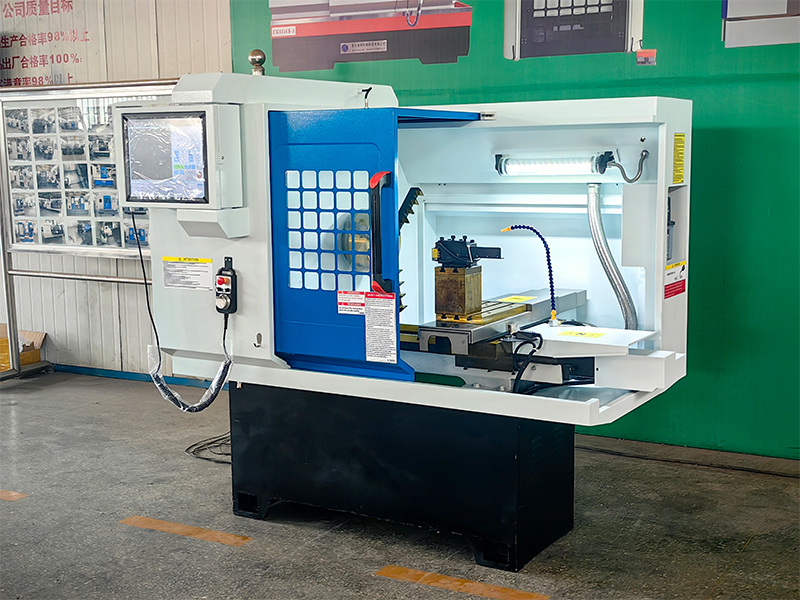
Horizontal wheel repair machines are familiar to many operators and work well for common refinishing tasks.
Vertical wheel repair lathes can offer strong accessibility and, in the right configuration, support both wheel spoke repair and wheel rim repair. For some workshops, a vertical setup improves workflow and machine footprint efficiency.
2.3 Detection and Programming
This is where machine performance often separates itself. Better detection means less setup time and more predictable cutting paths.
A strong alloy wheel repair machine should support reliable wheel profile detection and easy path correction. Shops that process high volume benefit from systems that minimize manual trial and error.
2.4 Ease of Learning
Many buyers focus on spindle power, travel, or chuck size and forget one practical issue: can staff learn it quickly?
If training is complicated, production drops. If operation is intuitive, you can put more technicians on the machine and avoid bottlenecks.
2.5 Upgradeability and Remote Support
Software flexibility matters more than many first-time buyers realize. Wheel designs continue to evolve, and repair systems need to stay current. Machines that support online upgrades, customization, and remote service are easier to keep productive over time.
3. Taian HAISHU: The Most Complete Option for Buyers Who Want Flexibility
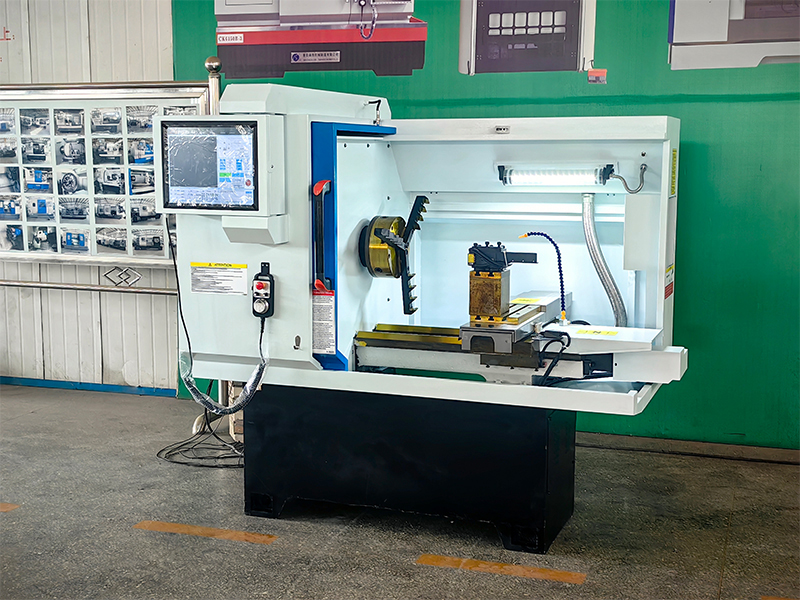
Among current options in the market, Taian HAISHU stands out for combining practical workshop usability, broad customization, and a dedicated wheel-repair-focused control system. For buyers looking for a scalable CNC Alloy Wheel Repair Machine lineup rather than a one-model solution, it deserves close attention.
3.1 Why Taian HAISHU Gets Serious Buyer Attention
Taian HAISHU offers both alloy wheel repair machine solutions and wheel straightening equipment, which is important for shops that want to build a full-service repair line.
Its system strengths are particularly relevant for real workshop use:
- 17-inch touch screen across the wheel repair machine series
- fully self-developed dedicated wheel repair system
- support for 130+ language customization
- customer logo embedding in the software system
- dedicated operation pages for different functions
- simplified one-stop interface
- customizable parameters based on operator habits
- Wi-Fi and online upgrades
- lifetime free software upgrades
- remote service support
For distributors, franchise operators, and workshops serving local-language teams, multilingual flexibility is not a small feature. It directly affects training speed and operator confidence.
3.2 Detection and Machining Features That Improve Practical Results
Taian HAISHU has built its system around actual wheel repair workflow rather than generic CNC operation. The platform supports:
- laser detection
- probe detection
- tool tip detection
Laser detection is included as standard, while the other tools can be added separately. Importantly, the software functions are available without extra software charging. That makes expansion more economical over time.
Other useful capabilities include:
- online curve optimization in automatic and manual modes
- real-time coordinate modification
- immediate machining depth and path adjustment during observation
- segmented curve repair and machining with fine cutting chips
- one-click program output
- one-click tool setting
- manual and automatic path optimization
For a shop buying a machine face wheel repair solution, these features matter because they shorten setup, reduce waste cuts, and help operators respond to different wheel conditions quickly.
3.3 Easy Learning Curve for Workshops
A machine may be technically advanced, but if the interface is difficult, it slows the whole shop. Taian HAISHU’s system is designed for fast adoption.
- Even users without CNC experience can learn the basics quickly.
- Many customers can master operation in about 30 minutes.
- Electronic and video tutorials support training.
- A handwheel unit improves operator control and convenience.
For repair shops hiring general technicians rather than seasoned CNC specialists, this is a meaningful advantage.
3.4 Mechanical Design and Hardware Benefits
Software alone does not produce stable cutting. Mechanical rigidity and clamping matter just as much.
Taian HAISHU emphasizes:
- cast iron base with high rigidity
- high-precision servo motors for stable performance and data retention
- extended jaw design for quicker clamping
- support for three-jaw, four-jaw, and six-jaw chucks
- self-designed extended fixtures for different wheel inspection needs
- complete accessories set
The machine also supports several tool holder options:
- gang tool holder
- manual four-station turret
- electric four-station turret
For most wheel refinishing work, the gang tool holder is the most practical choice because:
- usually only one tool is needed
- no turret rotation is required
- it is more cost-effective
- it has fewer mechanical failure points
- maintenance is easier
- replacement cost is lower
3.5 Strong Customization for Distributors and End Users
Taian HAISHU is especially attractive to OEM buyers, importers, and workshops wanting tailored branding.
Customization options include:
- voltage options: 110V, 220V, 380V, 415V
- machine appearance customization in shape and color
- customizable wheel model settings
- logo embedding in the system
- custom machine nameplate
This is useful for businesses that want to present the machine as part of a branded service package.
3.6 Taian HAISHU Model Lineup
Below is a practical summary of the lineup.
| Model | Type | Capacity | Key Notes | Price Range |
| CK6160Q | Horizontal wheel hub repair machine | Up to 24 inches | 4kW main motor, X/Z servo 4N/6N, customizable for extended needs | USD 5,000–7,000 |
| CKL-24Q | Portable vertical wheel hub repair machine | Up to 24 inches | Split portable design, casters, multilingual touchscreen, mobile service friendly | USD 4,500–5,500 |
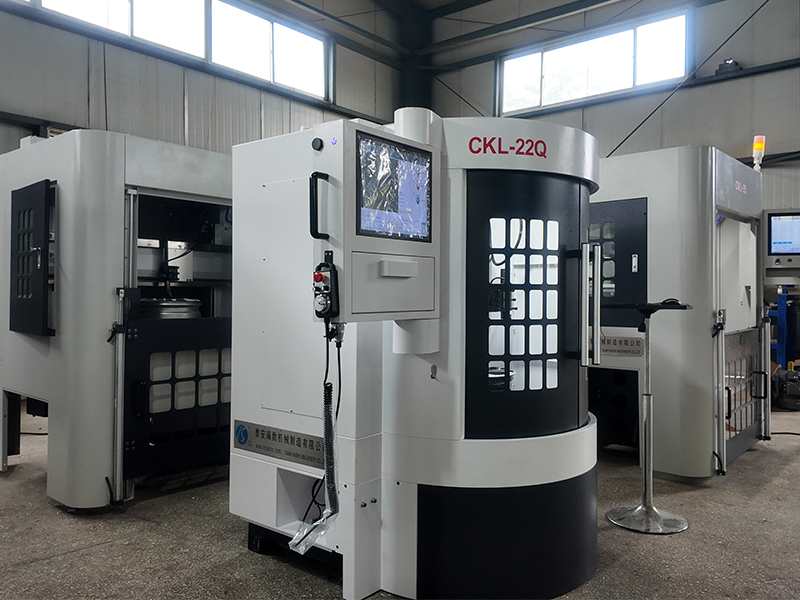
| CKL-22Q | Upgraded vertical wheel hub repair lathe | Up to 24 or 26 inches | 4kW motor, 6N/15N servos, better rigidity, enclosed design | USD 6,000–8,000 |
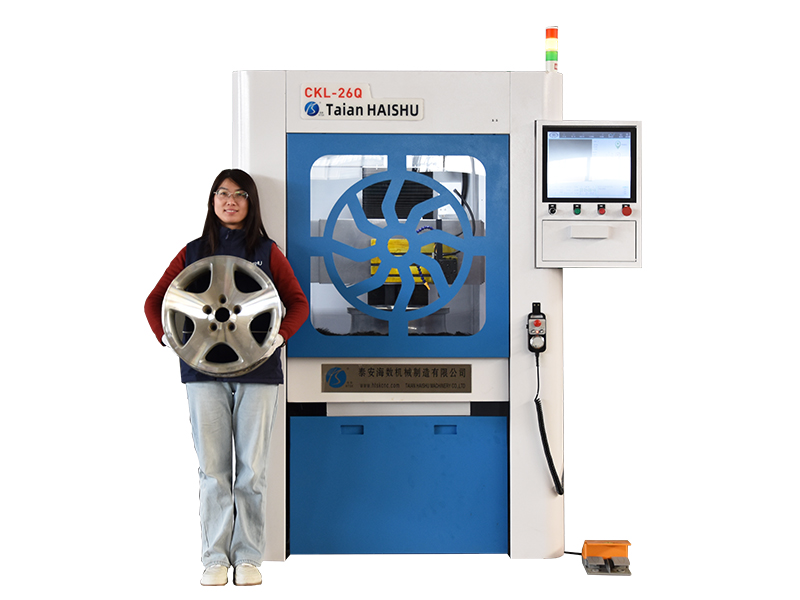
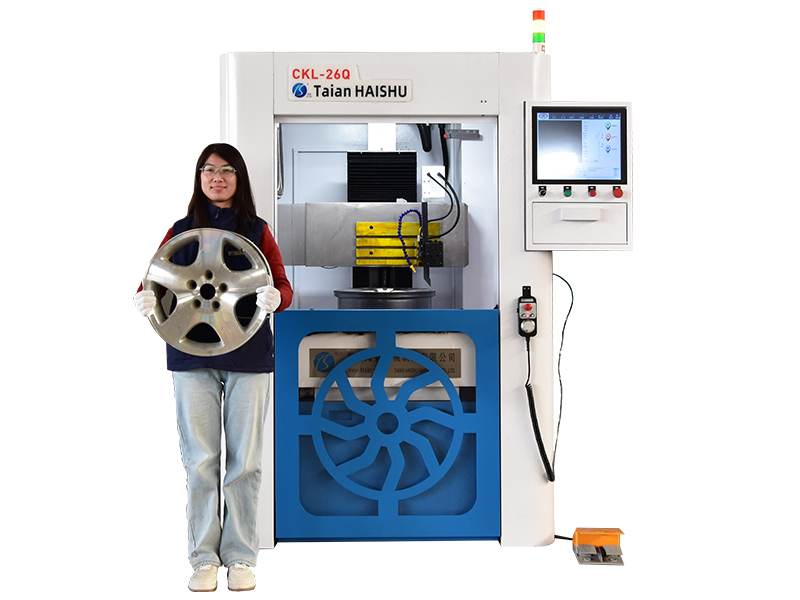
| CKL-26Q | High-value vertical wheel hub repair machine | Up to 26 inches | Cost-effective, pneumatic or sliding door options | USD 7,000–9,000 |
| CKL-35 | Large wheel hub repair machine | Up to 35 inches | Double-column gantry-style structure, 3 servo motors | USD 8,000–12,000 |
| CKL-35P | Upgraded custom version | Up to 35 inches | 900 mm Z travel, 5.5kW motor, enlarged 320 mm chuck | USD 9,000–14,000 |
| RSM595 | Wheel straightening machine | Up to 26 inches | Automatic hydraulic version, 10-ton press force | USD 1,000–1,800 |
3.7 What Buyers Should Know About the Main Taian HAISHU Machines
3.7.1 CK6160Q
The CK6160Q is a horizontal wheel hub repair machine for wheels up to 24 inches. It is a practical choice for workshops that want a stable wheel refinishing machine for mainstream passenger vehicle work. With a standard 4kW main motor and X/Z servo motors rated 4N/6N, it balances affordability and everyday usability.
Best for:
- standard repair shops
- body shops adding wheel services
- workshops seeking a proven wheel repair lathe
3.7.2 CKL-24Q
The CKL-24Q is one of the most interesting models in the lineup because it is a portable vertical wheel hub repair machine. It uses the independent 17-inch multilingual wheel repair system, supports 110V–440V, and works with laser, probe, and cutter tip detection.
It includes:
- one-touch tool setting
- optimization and program output
- support for up to 24-inch wheels
- custom programs and logo branding
- split portable design with casters
- weight at or below 500 kg
- safety doors
- automatic lubrication
- optional video recording
- diamond cutting tools
This model suits mobile wheel repair, compact workshops, and buyers who need portability without losing CNC capability.
3.7.3 CKL-26Q
The CKL-26Q is one of the best-value options in the range. It is a high-value vertical wheel hub repair machine with capacity up to 26 inches, making it suitable for shops serving larger OEM and aftermarket wheels. Door options include pneumatic upgraded doors or switch-style sliding doors.
For many buyers, this model hits the strongest balance between capability and investment.
3.7.4 CKL-35
The CKL-35 is the largest wheel hub repair machine in the standard lineup. With capacity up to 35 inches, double-column structure, gantry-style design, and three 6N servo axes, it is built for larger wheel sizes and wider machining range. Chuck options include 250 mm and 320 mm.
This machine is suitable for specialty wheel businesses, custom wheel service providers, and workshops that do not want wheel diameter to become a sales limitation.
3.7.5 RSM595
The RSM595 is not a refinishing lathe. It is a wheel straightening machine, and that distinction matters. It handles wheels up to 26 inches, offers 10 tons of hydraulic press force, and can cut the solder joint of car alloy wheels. For shops building complete rim repair equipment capability, this machine fills the structural repair role efficiently.
Taian HAISHU also offers the RSM585, a manual hydraulic version, while the RSM595 is the automatic hydraulic version.
4. Comparison Table: What Buyers Should Compare First
4.1 Fast Evaluation Matrix
Before reviewing brands, compare machines on the metrics that affect profitability.
| Buying Factor | Why It Matters | What to Look For |
| Wheel size capacity | Determines service range | 24″, 26″, or 35″ depending on market |
| Detection system | Reduces setup errors | Laser standard, optional probe/tool tip |
| Control interface | Speeds training | Large touch screen, simple operation pages |
| Software upgrades | Protects long-term value | Wi-Fi, online upgrade, lifetime updates |
| Machine rigidity | Affects finish consistency | Cast iron base, stable servo system |
| Chuck and fixture flexibility | Improves clamping speed | 3-jaw, 4-jaw, 6-jaw compatibility |
| Straightening support | Expands service scope | Dedicated rim straightening machine availability |
| Branding customization | Useful for distributors | Logo embedding, nameplate customization |
| Voltage adaptability | Simplifies export or installation | 110V to 415V options |
| Training and remote support | Reduces downtime | Video tutorials, remote service |
5. Review of 8 Wheel Refinishing Machine Brands
Below are 8 brands worth considering when buying a CNC Alloy Wheel Repair Machine. Taian HAISHU is reviewed first because of its broad product lineup, strong software system, and practical customization advantages.
5.1 Taian HAISHU
Main advantages:
- broad machine lineup from portable vertical to large gantry-style models
- dedicated wheel repair software rather than generic CNC adaptation
- 17-inch touchscreen interface across the series
- 130+ language customization
- Wi-Fi, remote service, and lifetime free software upgrades
- three detection modes: laser, probe, tool tip
- strong customization for voltage, appearance, nameplate, and embedded logo
- integrated wheel straightening machine option through RSM595
- easy learning curve for operators without CNC background
Best for:
- repair shops
- importers and distributors
- buyers wanting a complete alloy wheel repair equipment solution
- businesses planning to scale from standard wheels to larger diameters
5.2 HBC System
Main advantages:
- established reputation in wheel refurbishment
- purpose-built systems for alloy wheel resurfacing
- strong recognition in professional refurbishment circles
Best for:
- buyers focused on premium refurbishment process consistency
- shops seeking recognized industrial wheel restoration equipment
5.3 COMEQ
Main advantages:
- broad machine tool background
- solid engineering reputation
- suitable for buyers who value robust machine construction
Best for:
- workshops that prefer machine-tool-oriented build quality
- industrial buyers comfortable with technical equipment
5.4 Kwik-Way
Main advantages:
- long-standing name in automotive machine equipment
- practical service support reputation in many markets
- familiar brand for automotive repair businesses
Best for:
- traditional automotive repair shops expanding into rim repair machine services
- buyers who value established aftermarket familiarity
5.5 Rim Doctor
Main advantages:
- strong niche focus on wheel repair and refinishing
- brand recognition in wheel restoration operations
- practical alignment with cosmetic wheel repair services
Best for:
- shops focused specifically on wheel restore machine applications
- operators looking at wheel cosmetic restoration as a core business
5.6 Hunter Engineering
Main advantages:
- respected automotive equipment brand
- strong dealer network in many regions
- trusted by larger service operations
Best for:
- larger workshops and dealer groups
- buyers seeking a familiar professional equipment ecosystem
5.7 CEMB
Main advantages:
- high reputation in wheel service equipment
- precision-oriented engineering background
- attractive for workshops already using wheel service systems
Best for:
- advanced tire and wheel service centers
- businesses prioritizing precision equipment integration
5.8 Pro-Cut
Main advantages:
- known for precision machining-related automotive service tools
- practical appeal to shops seeking clean finished surfaces
- recognized in service environments that value machining accuracy
Best for:
- workshops emphasizing finish quality and process repeatability
- service centers expanding premium cosmetic wheel repair
6. How to Match the Machine to Your Business Type
6.1 For Auto Repair Shops
If you are an auto repair shop owner adding wheel restoration as a profit center, you usually need:
- easy training
- compact footprint
- reasonable budget
- reliable finish quality
A model such as CK6160Q or CKL-24Q is often a practical entry point. Pairing it later with an RSM595 wheel straightening machine creates a stronger service package.
6.2 For Dedicated Wheel Refurbishment Workshops
If wheels are already a core business, choose based on throughput and wheel diversity. A CKL-26Q gives broader wheel range and strong value, while a CKL-35 supports oversized wheels and specialty jobs. Adding a rim fixing machine or wheel rim straightening machine is essential if structural damage is common.
6.3 For Mobile Wheel Repair Services
Mobility changes the buying criteria. Weight, portability, voltage flexibility, and operating simplicity become critical. The CKL-24Q is especially suitable here because of its split portable design, caster support, multi-voltage compatibility, and compact format.
6.4 For Investors and Equipment Buyers
If you are evaluating return on investment, focus on:
- average repair ticket value
- number of wheels processed per week
- operator learning speed
- machine downtime risk
- consumable cost
- ability to serve larger wheel sizes
- whether straightening is included or sold separately
A shop that only offers cosmetic cutting leaves money on the table when bent wheels arrive. Combining a wheel refinishing machine with a wheel straightening equipment setup improves service capture.
7. Cost, ROI, and Buying Strategy
7.1 What Price Really Means
Buyers often compare machine prices without comparing capability. That is risky. A cheaper alloy wheel lathe may cost more long term if setup is slow, support is weak, or finish quality is inconsistent.
For example:
- an entry-level portable alloy wheel repair machine may be enough for mobile cosmetic work
- a larger vertical or gantry design may be better for premium wheel specialists
- a separate hydraulic wheel straightener can dramatically improve service range at relatively low cost
7.2 Example Budget Logic
| Business Type | Recommended Setup | Typical Investment Logic |
| Small shop entering wheel repair | CK6160Q or CKL-24Q | Low-to-mid budget, fast entry |
| Mobile repair service | CKL-24Q | Portability and multi-voltage matter most |
| Mid-volume refurbishing center | CKL-26Q + RSM595 | Best balance of refinishing and straightening |
| Large wheel specialist | CKL-35 or CKL-35P + RSM595 | Broader wheel size coverage and higher-value jobs |
7.3 Wheel Restore Machine Price vs. Profitability
When buyers search wheel restore machine price, they often focus too narrowly on the purchase number. The more useful metric is payback speed.
A machine that helps you complete more jobs per day, reduce rework, and accept larger wheels can justify a higher upfront cost. The same applies to alloy wheel refurbishment equipment with software upgrades and remote support: less downtime often means better cash flow.
8. Common Buying Mistakes to Avoid
8.1 Buying Only for Today’s Jobs
If your area is shifting toward larger SUVs, EVs, and premium aftermarket wheels, buying a machine capped too low may force another investment sooner than expected.
8.2 Ignoring Straightening Capability
A refinishing machine alone does not solve bent-wheel cases. If structural damage is common in your market, plan for a wheel straightening machine from the start.
8.3 Overlooking Operator Experience
A complicated control system can kill productivity. An intuitive system with tutorials, one-click functions, and clear operation pages is often more profitable than a machine with impressive but underused features.
8.4 Neglecting Service and Software
Machines are not static assets. Updates, remote service, and software support matter. A machine with lifetime free upgrades offers a real long-term advantage.
9. Final Buying Recommendation
Choosing the best CNC Alloy Wheel Repair Machine comes down to fit, not hype. Buyers should prioritize wheel size range, rigidity, detection accuracy, software ease, training time, and after-sales support. If you want a practical, scalable solution with strong customization and a complete lineup, Taian HAISHU is one of the most compelling choices to evaluate first.
Its lineup covers multiple business models:
- CK6160Q for dependable horizontal refinishing up to 24 inches
- CKL-24Q for portable vertical repair and mobile service
- CKL-26Q for strong value up to 26 inches
- CKL-35 for larger wheel applications up to 35 inches
- RSM595 for wheel straightening and structural correction
For buyers seeking a wheel repair machine, rim repair equipment, alloy wheel straightening machine, or full wheel refinishing machine plus straightening setup, the most effective strategy is to buy for your real repair flow, not just the lowest quote.
The best machine is the one that helps your shop finish wheels faster, train operators easier, accept more jobs, and deliver results customers are willing to pay for.


