Top 10 Fully Automatic Wheel Repair Machines Reviewed
1. Two Jobs, Two Machines, One Shop Decision
A scuffed diamond-cut face and a buckled barrel are not the same repair. One is a cutting job. The other is a pressing job. Shops that treat them as one purchase usually buy the wrong fully automatic wheel repair machine, then keep sending half the work out.
Diamond-cut faces, polished lips, and machined spokes need an alloy wheel lathe. The cutter takes a thin, controlled skin off the damaged surface and leaves a finish the painter or clear-coat line can actually use. A bend, a flat spot, or a shifted bead seat needs wheel straightening equipment. Force goes where the metal moved, and the rim comes back toward round before anyone talks about cosmetics.
Most busy tire and wheel shops eventually need both. A car rim repair machine that only cuts cannot pull a hard buckle straight. A rim straightening machine that only presses cannot restore a factory machined face. The buying mistake is not “which brand is famous.” It is matching the machine to the wheels already sitting in the rack.
1.1 What comes through the door
Passenger-car alloys in the 17 to 22 inch range still make up the bulk of everyday work. SUVs, light trucks, and some European performance cars push that toward 24 inches and beyond. A few commercial and aftermarket wheels land in the low 30s. If those larger rims show up even once a week, a 22 inch machine will become a bottleneck, not a bargain.
Spoke damage is a separate question. Vertical wheel repair machines can reach spoke faces as well as the rim lip, which matters on open-spoke designs where the customer can see every cutter mark. A horizontal wheel repair lathe is often the better fixed-bay choice when the work is mostly outer-face refinishing and the operator wants a familiar lathe layout.
Mobile work changes the spec again. A van-based operator needs a machine that splits, rolls, and runs on whatever power the site actually has. A 1.5 ton gantry lathe does not belong in a van, no matter how good the finish is.
1.2 Who is actually buying
Repair shop owners usually start with one painful number: how many diamond-cut or bent rims they turned away last month. Equipment buyers and distributors look at voltage, language, branding, and how fast a new operator becomes useful. Investors look at the same things from the other side. A machine that only one technician can run, in one language, on one voltage, is a fragile asset. A wheel refinishing machine that a second tech can learn in a shift, and that can be badged for a local dealer network, is easier to scale.

2. What to Check Before You Compare Brochures
Price is the last filter, not the first. A cheap rim repair machine that cannot hold a curve, or that needs a CNC veteran to run it, costs more per finished wheel than a clearer mid-range alloy wheel CNC machine.
2.1 Capacity, detection, and the cut itself
Start with maximum wheel diameter, then chuck size, then how tall a deep-dish wheel can sit in the machine. Diameter without height is how buyers get surprised by concave designs.
Detection is the next split. Laser scanning is fast and does not touch the wheel. A probe is slower and often better on sharp edges and complex spokes. Tool-tip detection checks the cutter itself, which matters once inserts wear and the program no longer matches the tool that is actually in the holder. A fully automatic wheel repair machine should let the operator correct the curve on the screen, in automatic or manual mode, without rewriting the whole job. Real-time depth changes, while the operator is watching the cut, save more wheels than an extra kilowatt of spindle power.
Chip form tells you whether the path is right. Segmented curve repair that leaves fine cutting chips is what you want on a cosmetic face. A heavy, torn chip on a diamond-cut lip usually means the path, the tool, or the feed is wrong, and the wheel will show it after clear coat.
2.2 The costs that do not sit on the price tag
Ask about servo holding, not just motor nameplates. A high-precision servo that keeps position after a stop is what makes the second wheel match the first. Ask what fails and what it costs to replace. A gang tool holder with one diamond tool, no turret index, and no extra station to crash is often the sensible shop choice. It is cheaper to buy, cheaper to repair, and there is less to go wrong on a Saturday. A manual or electric four-station turret is there when the work truly needs tool changes in one setup. It is not automatically the better buy.
Power is a site problem, not a catalog detail. 110V, 220V, 380V, and 415V shops all exist, sometimes in the same dealer group. A machine locked to one supply becomes a used-equipment problem the day it is moved.
| Check | Why it changes the purchase |
| Max diameter and wheel height | Stops you refusing the wheels you already see |
| Laser, probe, and tool-tip detection | Different wheels need different ways to find the surface |
| On-screen curve edit during the cut | Saves a wheel instead of scrapping a program |
| Servo holding and cast-iron stiffness | Repeatability after lunch, not just on the demo wheel |
| Voltage and language options | Matters the moment the machine moves or the operator changes |
| Tooling layout | Gang tooling is often cheaper to own than a turret you rarely index |
| Straightening force, if bends are in the mix | Cutting will not fix a barrel that is no longer round |
3. Taian HAISHU
Taian HAISHU builds both sides of the job: alloy wheel repair refinishing machines and a separate hydraulic straightening line. That split is useful. You can buy a lathe without paying for a press you do not need, or add a wheel straightening machine later without pretending the lathe was a straightener.
The control side is the part worth understanding before the model numbers. Wheel repair machines in the series use a 17-inch touchscreen and a dedicated wheel repair system, not a general machine-tool screen with a wheel macro bolted on. Each function has its own page. Parameters can be set around how a shop actually works, rather than how a programmer prefers to nest menus. Language can be customized across a very wide set, on the order of 130 languages, and a distributor can embed a customer logo in the system and put its own name on the machine plate. For an investor placing machines with local partners, that is practical, not decorative.
Wi-Fi and online upgrades are built in, with lifetime free software upgrades and remote service when a job stalls. New operators are not expected to arrive with CNC time. Shops that have put people on these machines generally see a usable operator in about half an hour, backed by electronic and video tutorials and a handwheel for the moments when the screen is the wrong tool. One-touch tool setting and one-click program output are part of that same idea: fewer steps between “wheel is clamped” and “program is ready.”
Laser detection is standard. Probe and tool-tip detection are separate purchases. The software functions that use them are not an extra license. Curve optimization works online in both automatic and manual modes, including real-time coordinate changes and depth or path edits while the cut is visible. Segmented curve machining is there for fine chips on faces that will be judged under paint-shop lights. Custom wheel model settings can be stored, which matters once a shop sees the same OEM design every week.
Mechanically, the bases are cast iron, chosen for rigidity rather than a light welded frame that looks fine on day one and chats under a heavy cut later. Extended jaws speed clamping. Three-jaw, four-jaw, and six-jaw chucks are supported, with extended fixtures for inspection setups that a standard chuck does not cover. Accessories come as a set, not as a scavenger hunt after delivery. The recommended tool layout for most wheel work remains the gang holder: usually one diamond tool, no turret rotation, fewer failures, simpler maintenance, and a lower replacement cost. Turret options exist when the job mix justifies them.
Vertical models in the line can do wheel spoke repair and wheel rim repair. That is the right question to ask if your photos of rejected work show spoke-face rash, not only lip rash.
3.1 CK6160Q horizontal alloy wheel repair refinishing machine
The CK6160Q is the horizontal wheel hub repair machine in the range. Standard capacity is wheels up to 24 inches, with room to customize if a shop’s mix runs past that in a specific way. It is a fixed-bay alloy wheel repair machine, not the portable unit. Guide price sits around USD 5,000–7,000, depending on how it is specified.
The standard main motor is 4kW. Servo motors on the X and Z axes are 4N and 6N. That is enough for normal passenger and SUV face work when the base is stiff and the path is right. It is not a substitute for the larger vertical machines if 30 inch wheels are a regular ticket. For a shop whose rack is mostly under 24 inches and whose operators already think in horizontal lathe terms, the CK6160Q is the straightforward refinishing buy. Diamond cutting tools are the normal consumable. Finish quality still depends on detection, tool condition, and how willing the operator is to trim the curve instead of forcing a bad path.
3.2 CKL-24Q portable vertical wheel hub repair machine
The CKL-24Q is the mobile piece. It is a portable vertical wheel hub repair machine with its own wheel repair system, the same 17-inch multilingual touchscreen, and a 110V–440V multi-voltage range. Laser, probe, and cutter-tip detection are all in the function set. One-touch tool setting, optimization, and program output are standard operating steps, not optional tricks.
Capacity is wheels up to 24 inches. The design splits, rides on casters, and stays at or under 500 kg, which is the difference between a machine you can place in a van and a machine you only move with a forklift and a plan. Safety doors, automatic lubrication, and optional video recording cover the points mobile operators actually get asked about by insurers and by customers who want a record of the cut. Custom programs and logo branding are available, so a mobile brand can look like itself on the screen, not like a generic controller.
Guide price is about USD 4,500–5,500. Among alloy wheel repair equipment aimed at mobile wheel repair, that is an entry that does not strip out detection or the dedicated system to hit the number. It will not replace a 35 inch gantry lathe. It will let a van or a small bay take diamond-cut work that currently leaves the building.
3.3 CKL-22Q upgraded vertical wheel hub repair lathe
The CKL-22Q is an upgraded vertical wheel hub repair lathe for shops that want more rigidity than a portable unit and do not yet need a 26 or 35 inch frame. Repair range is up to 24 inches, or 26 inches depending on the build agreed at order. Motor power is 4kW, with 6N and 15N servo motors. The fully enclosed design and the step up in machining rigidity are the reasons to choose it over a lighter vertical machine when the cut is heavier or the shift is longer.
Guide price is about USD 6,000–8,000. It sits in a sensible place for a first fixed vertical wheel repair lathe: more structure than the portable model, less floor space and less money than the large-capacity machines.
3.4 CKL-26Q vertical alloy wheel repair refinishing machine
The CKL-26Q is the high-value vertical wheel hub repair machine in the line, and one of the more cost-effective Taian HAISHU models if 26 inches is your real ceiling. Door choice is practical rather than cosmetic: pneumatic upgraded doors, or switch-style sliding doors. Pick the one your bay and your operators will actually live with. A door that fights the tech gets left open, and then the safety spec on the quote is fiction.
Guide price is about USD 7,000–9,000. For many independent shops, this is the alloy wheel lathe that covers the local car and SUV mix without paying for 35 inch capacity they will use twice a year. It is still a refinishing machine. Bent barrels still belong on a hydraulic wheel straightener.
3.5 CKL-35 and CKL-35P large-capacity refinishing machines
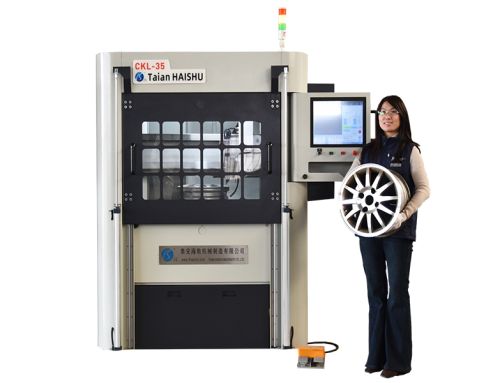
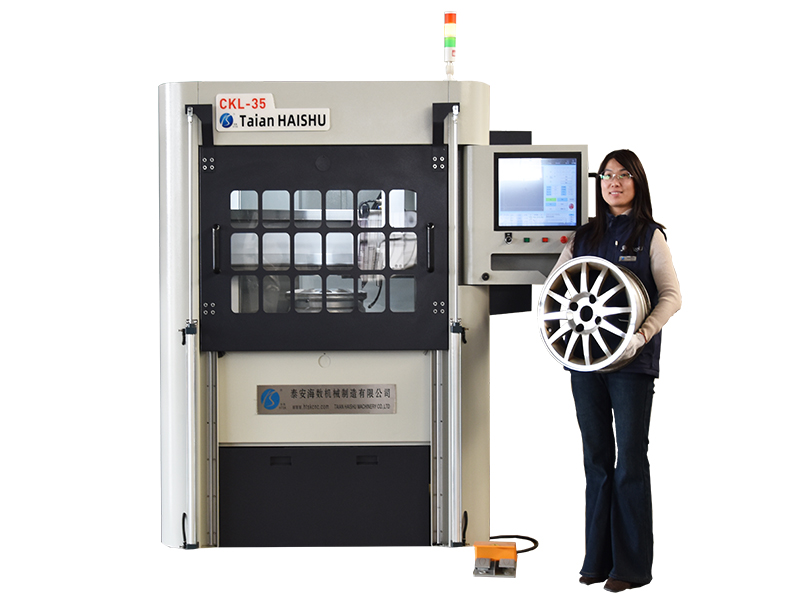
The CKL-35 is the largest wheel hub repair machine in the standard line, with capacity up to 35 inches. The structure is double-column and gantry-style, which is what you want once wheel diameter and chuck loads leave the compact vertical class. Three servo motors are used, with a 6N design on all three axes. Chuck options are 250 mm or 320 mm. Guide price is about USD 8,000–12,000.
The CKL-35P is the upgraded custom version, the Pro/Plus build of the same platform. Z-axis travel is 900 mm. It can repair wheel hubs up to 550 mm in height, which is the spec that matters on deep-dish and high-offset designs more than another inch of nominal diameter. Maximum wheel size remains 35 inches. The standard chuck is an enlarged 320 mm three-jaw, with four-jaw or six-jaw optional. Main motor power is 5.5kW. Machine weight is about 1.6 tons. Guide price is about USD 9,000–14,000.
These are shop machines, not van machines. A wheel refurbishment center, a dealer group, or an investor fitting out a dedicated bay is the right buyer. The extra money over a CKL-26Q is justified only if large diameter or tall hubs are real work, not a hope.
3.6 RSM595 and RSM585 wheel straightening machines
The RSM595 is the automatic hydraulic wheel straightening machine. Maximum wheel size is 26 inches. Hydraulic press force is 10 tons. Guide price is about USD 1,000–1,800, which puts a proper alloy wheel straightening machine within reach of shops that cannot yet justify a lathe, or that already have a lathe and still lose bent rims to specialists. It can also cut the solder joint on car alloy wheels, which comes up when a previous repair has left a joint that has to be opened before the rim can be brought back.
The RSM585 is the manual hydraulic version in the same special straightening lineup. It suits a lower volume of bends, or a shop that wants the operator’s hand on the force rather than an automatic cycle. Price should be requested with the RSM595 rather than assumed from the automatic model. Neither machine is a wheel refinishing machine. They do not replace diamond cutting. They stop you from cutting a rim that is still out of shape, which is how cosmetic repairs fail comeback inspection.
3.7 HAISHU model snapshot
| Model | Type | Max wheel | Notable spec | Guide price (USD) |
| CKL-24Q | Portable vertical refinishing | 24 in | Split design, ≤500 kg, 110–440V | 4,500–5,500 |
| CK6160Q | Horizontal refinishing | 24 in, customizable | 4kW main motor, X/Z servo 4N/6N | 5,000–7,000 |
| CKL-22Q | Upgraded vertical lathe | 24 or 26 in | 4kW, servo 6N/15N, enclosed | 6,000–8,000 |
| CKL-26Q | Vertical refinishing | 26 in | Pneumatic or sliding doors | 7,000–9,000 |
| CKL-35 | Gantry vertical refinishing | 35 in | Double column, three 6N servos, 250 or 320 mm chuck | 8,000–12,000 |
| CKL-35P | Upgraded CKL-35 | 35 in, hub height to 550 mm | 5.5kW, Z travel 900 mm, 1.6 t, 320 mm chuck | 9,000–14,000 |
| RSM595 | Automatic hydraulic straightener | 26 in | 10 ton press, solder-joint cutting | 1,000–1,800 |
| RSM585 | Manual hydraulic straightener | Same lineup class | Hand-controlled force | Ask with the RSM595 |
Prices move with voltage, chuck, doors, detection tools, and tooling. Treat the bands as a budget check, then ask for a configured quote.
HAISHU is a reasonable shortlist when you want refinishing and straightening from one maker, when operators will not be career CNC machinists, and when language, logo, voltage, or remote support actually matter to how you sell the service. It is not the only serious option. European and American makers below solve different problems, often at a different price, and some of them solve those problems very well.


4. Wheel Restore
Wheel Restore, part of Denmark’s HBC Systems, builds a fully automated diamond-cut alloy wheel repair machine around a short, guided cycle rather than a general-purpose lathe layout. The WR-DCM3 is the machine most shops mean when they ask about this brand. Laser probing, a stored wheel library, and a touchscreen controller are the working core. A widely cited operating point is that the tire can stay on the wheel, which removes a changer cycle from every ticket.
The same group offers an electro-hydraulic wheel straightener, so a buyer can think about bends and faces together, though not in one frame. The software is purpose-built in Denmark, and the machines are sold into workshop and mobile smart-repair setups, including van installations, on ordinary single-phase power with a compact footprint.
Main advantages: a fast automated cycle aimed at diamond-cut restoration, tire-on processing, a clean operator interface, and a European support path through an established smart-repair equipment group. Shops comparing a wheel restore machine price against a conventional alloy wheel CNC machine should price the whole ticket time, including tire handling, not only the machine invoice. This is a specialist restore machine, not a heavy gantry lathe for oversized commercial wheels.
5. DCR Systems
DCR Systems designs its alloy wheel repair equipment in the UK and builds for both fixed workshops and van-based diamond-cut businesses. The DCR Pro is the lathe most operators associate with the name. It was developed so a refinishing business could run from a vehicle without giving up a controlled cut, and the same small footprint also sits in a bay when the work stays in-house.
What separates DCR from a lathe-only maker is the rest of the process. Blasting equipment and an automated painting machine sit in the same product family. A shop that wants to sell a finished wheel, not only a machined face, can keep cut, surface prep, and paint conversation with one supplier. Distribution already reaches a wide set of markets outside Britain.
Main advantages: UK design and build, a mobile-first alloy wheel diamond cutting machine that also works as a static unit, and a wider alloy wheel refurbishment equipment set that includes blast and automated paint. The strength is the process around the lathe, not maximum wheel diameter alone.
6. Mint Alloys
Mint Alloys supplies static and mobile alloy wheel lathes under the Alloy Wheel Lathes range, aimed squarely at diamond-cut refurbishment in the UK and nearby markets. The TY30-VS is the static machine: a ribbed cast-iron frame, linear-rail cross slide, and a compact footprint that still covers wheels from 14 inches to 30 inches. That upper size is the number to remember if your work regularly passes 26 inches but you do not want a full gantry installation.
The TY23 family is built around a simple site requirement. It runs on a 240V single-phase supply, which the maker describes as plug-and-cut for shops that do not have three-phase on the wall they plan to use. The TY23VSM is the lightweight mobile version for van work, designed so cut quality is not the thing you give up to save weight.
Main advantages: a clear static-versus-mobile split, cast-iron stability on the larger static lathe, 30 inch capacity on the TY30-VS, and single-phase simplicity on the TY23. This is wheel refinishing equipment for diamond-cut businesses, not a rim straightening line.


7. Lehigh
Lehigh is a US supplier known in the wheel remanufacturing trade for CNC wheel refinishing machines, alongside manual and CNC lathes and wheel straightening equipment. The MR-2540 is the model that production shops tend to name. Remanufacturers who run diamond-cut work as a daily production job, rather than as an add-on to tire service, have used these lathes for high annual rim counts over multiple years. That usage pattern is the useful signal. A machine that survives continuous face work is a different buy from a machine that looks good on a two-wheel demonstration.
Programming is generally described by users in that trade as straightforward, which matters when more than one person has to keep a cell running. Parts and application support sit in the US, which is a real advantage if your shop, your electrician, and your downtime all live on that side of the logistics chain.
Main advantages: a production-proven wheel repair lathe reputation in remanufacturing, US-based supply, and a catalog that already includes straightening as well as refinishing. It is a stronger fit for volume machine face wheel repair than for a one-van startup watching every kilogram.
8. COMEC
COMEC, in Italy, is a workshop-equipment maker whose rim repair equipment includes the RSM240 rim straightening machine and lathe. The working idea is practical. A hydraulic cylinder, with regulated pressure and a gauge, pushes the damaged section back using shaped punches matched to the profile. After the metal is moved, a lathe unit can clean edge damage so the rim is not handed back with a straightened barrel and a torn bead edge.
The stated application range covers steel, aluminium, and alloy wheels from the low teens of inches through 24 inches. Punch force is in the light-to-medium class compared with a 10 ton dedicated press, so this is a professional car and light-commercial tool, not a heavy truck straightener. The package includes centering rings, a gauge, a set of tips, and a rim cutting tool. It is compact enough for a normal bay.
Main advantages: straighten and edge-clean in one Italian workshop machine, adjustable push force so the operator is not guessing on soft alloy versus steel, and a complete accessory set aimed at everyday rim fixing rather than diamond-cut face restoration. Do not buy it expecting a full alloy wheel diamond cutting machine. Buy it when the backlog is bends, dents, and bead-edge damage on wheels up to 24 inches.
9. ZETAMAK
ZETAMAK, based in Izmir, builds hydraulic rim straightening machines used across alloy, chrome, mag, and steel wheels. The RSM2400, RSM2600, and RSM2800 family covers roughly 10 to 24, 26, or 28 inches depending on the model. Larger coverage is the reason many importers look here. A shop that sees 28 inch aftermarket wheels cannot use a 24 inch straightener and call the job done.
The machines use a hydraulic pump in the 5 ton class on the common chrome-bar versions, with molded flanges, a set of press tips, and lathe support on specified models so a tech can address edge defects after the press work. They are CE certified, and the maker’s spare-parts position is long, which matters more in year six than on delivery day. Voltage options cover single-phase and three-phase supplies.
Main advantages: a wide size ladder up to 28 inches, a straightforward hydraulic wheel rim straightening machine layout, certification for export buyers, and a parts story that importers can explain to their own customers. This is rim repair equipment for correction and light edge work. It is not a CNC wheel refinishing machine, and it should not be priced as one.
10. ATEK MAKINA
ATEK MAKINA, in Istanbul, builds professional rim straighteners, including the Pangea series, for alloy and steel rims across about 10 to 28 inches. The feature buyers repeat is access. A 360-degree working layout lets the operator reach the damage without fighting the machine for position, which is a daily annoyance on straighteners that only open from one side.
Hydraulic power is the correction method, consistent with the rest of the serious rim fixing machine market. The range is aimed at professional service shops rather than occasional DIY use, and the size coverage overlaps the upper end of aftermarket passenger and SUV wheels.
Main advantages: open access around the wheel, a 10 to 28 inch hydraulic range, and a professional-series build intended for shops that straighten rims all week. Like the other dedicated presses in this review, it solves shape. Pair it with an alloy wheel lathe if the customer is paying for a machined face, not only a round rim.
11. Ten Machines Worth Pricing on the Same Sheet
“Fully automatic” is used loosely in this trade. Some machines automate probing, path building, and the cut. Others automate the hydraulic cycle on a bend and still expect the tech to read the rim. Both can be the right purchase. They are not interchangeable.
| Machine | Maker | Job | Size focus | Where it fits |
| CKL-24Q | Taian HAISHU | Vertical diamond-cut refinishing | To 24 in, portable | Mobile or first small bay |
| CK6160Q | Taian HAISHU | Horizontal refinishing | To 24 in | Fixed bay, familiar lathe layout |
| CKL-26Q | Taian HAISHU | Vertical refinishing | To 26 in | Main shop mix, cost-conscious |
| CKL-35 / CKL-35P | Taian HAISHU | Large vertical refinishing | To 35 in, tall hubs on P | Dedicated or high-spec bays |
| RSM595 | Taian HAISHU | Automatic hydraulic straightening | To 26 in, 10 ton | Bends, including solder-joint work |
| WR-DCM3 | Wheel Restore | Automated diamond-cut restore | Typical car alloys, tire-on | Fast smart-repair cycle |
| DCR Pro | DCR Systems | Mobile and static diamond cut | Van or compact bay | Cut plus a wider finish process |
| TY30-VS | Mint Alloys | Static diamond-cut lathe | 14–30 in | UK-style refinishing bay |
| MR-2540 | Lehigh | Production CNC refinishing | High daily volume | Remanufacturing cells |
| RSM240 | COMEC | Straighten, then edge-clean | About 12–24 in | European workshop correction |
ZETAMAK’s larger RSM models and ATEK’s Pangea series belong on the same sheet whenever 26 to 28 inch straightening is the actual gap. They did not lose a place because the work is unimportant. They lost a place on a ten-line table because the table already includes three straighteners’ worth of thinking, and diameter is the line that should force a separate quote.
A fair wheel restore machine price comparison also has to include options. Detection tools, chucks, doors, voltage, and whether a lathe unit is fitted on a straightener move the invoice more than a brochure starting price. Ask each supplier for the same wheel list: your five most common diameters, one deep-dish sample, one spoke-damaged sample, and one hard buckle. The machine that finishes that set cleanly is the one to negotiate, even if it was not the lowest line on the first email.
12. Matching the Purchase to the Work You Already Have
Count last quarter’s rejected wheels before you count features. If most rejects are diamond-cut rash on 17 to 22 inch faces, a vertical or horizontal refinishing machine to 24 inches is enough. The CKL-24Q is the one to price if that work must travel. The CK6160Q is the one to price if the bay is fixed and operators prefer a horizontal alloy wheel repair machine. The CKL-22Q or CKL-26Q makes more sense when you want a stiffer enclosed vertical lathe and your mix touches 26 inches.
If the rack includes 30 inch and larger wheels, or hubs tall enough to embarrass a short Z travel, stop looking at compact machines. The CKL-35 and CKL-35P exist for that work. Mint Alloys’ TY30-VS is the other refinishing machine in this review with a stated path through 30 inches, and it should be on the quote list for buyers who want a UK static lathe in that band. Lehigh belongs in the conversation when the plan is production volume, not a side service next to tire changes. Wheel Restore and DCR belong in it when cycle time, tire-on handling, or a van-based smart-repair model is the business, not maximum commercial diameter.
If the rejects are bends, buy a press. The RSM595 is the low-capital automatic hydraulic wheel straightener in the HAISHU line, with 10 tons and 26 inch coverage, plus the ability to cut a solder joint. The RSM585 is the manual alternative when volume does not justify the automatic cycle. COMEC’s RSM240 is the integrated European choice when you want regulated force and an edge lathe on the same machine, inside 24 inches. ZETAMAK and ATEK are the names to request when 28 inch rims and open access matter more than CNC cosmetics.
Many shops need a pair, not a compromise. A common workable set is one refinishing lathe plus one wheel rim repair machine for straightening. Cutting a bent rim wastes a diamond tool and still fails the customer. Straightening a rash and calling it refinished fails the customer in a different way. Machine wheel repair only pays when the process matches the damage.
For distributors and investors, add three commercial checks to the technical ones. Can the interface run in the languages your technicians actually speak? Can the machine name and your logo sit on the system and the plate? Can voltage be set for the next country, not only the first installation? Those are the details that decide whether a second and third unit are easy to place. Taian HAISHU is built around that kind of order. Several of the European makers are built around a tighter regional support promise instead. Neither approach is fake. They suit different ownership plans.
13. What to Settle Before You Place the Order
Send the supplier a short spec, not a one-line “best price.” Include maximum wheel diameter and the tallest hub you intend to clamp, preferred voltage, whether the machine must move, and whether spoke faces are in the work. State if you need laser only or also probe and tool-tip detection. State gang tooling unless you have a real reason for a turret. Ask who answers when a program misbehaves on a Tuesday afternoon, and whether software updates stay free after the warranty year.
On a Taian HAISHU refinishing machine, confirm the model against the table above rather than against a nickname. Horizontal CK6160Q, portable CKL-24Q, upgraded CKL-22Q, CKL-26Q, CKL-35, and CKL-35P are not interchangeable trims of one lathe. On the straightening side, confirm automatic RSM595 against manual RSM585, and do not confuse either with another maker’s RSM model number. The letters overlap. The machines do not.
Guide prices in the HAISHU bands are a planning tool. A configured quote, with chuck, doors, detection, voltage, and branding written down, is the number that belongs in a loan application or a partner agreement. If you are comparing that quote with Wheel Restore, DCR, Mint Alloys, Lehigh, COMEC, ZETAMAK, or ATEK, use the same wheel samples and the same question: finished wheel, or only one step of the repair?
Shops that already lose diamond-cut and bent-rim work are not short of demand. They are short of the right wheel repair machine, the right rim repair machine, or both. Price the configuration that matches the rack, then ask for the quote. That is the useful next step, and it is a better use of a week than reading another brochure that never states diameter, force, or what the operator has to know on day one.