Top 10 OEM Wheel Repair Machines Reviewed for Shops
A bent lip and a scratched diamond-cut face are two different repair jobs. One needs controlled force. The other needs a clean tool path and a light cut. Shops that buy one machine and expect it to do both usually end up sending half their work out, or worse, cutting a wheel that should have been rejected.
An OEM Wheel Repair Machine, in the sense that matters to a workshop or an equipment investor, is a machine built for this trade: configurable voltage, a control written for wheels rather than general turning, and a price that can be recovered from paid repairs. The ten machines below cover the decisions most buyers actually face. Eight builders are reviewed after that, starting with the lineup that spans portable refinishing, large-format cutting, and hydraulic straightening.
1. What a Working Shop Should Judge First
1.1 Face cutting and straightening solve different failures
Curb rash, clear-coat failure, and a dull machined face are cosmetic. A wheel refinishing machine or alloy wheel lathe removes a thin layer and leaves a surface that can be lacquered. A wheel straightening machine does not do that job. It pushes a bent section back toward round so the tire can seat and the wheel can be balanced.
Mixing those tasks on one bench is possible only on a few combination presses that include a light edge lathe. It is not the same as diamond cutting a face. If the shop’s advertised service is diamond-cut refurbishment, the core purchase is an alloy wheel diamond cutting machine. If the inbound work is pothole bends and cracked-looking lips, the core purchase is wheel straightening equipment. Many profitable shops run both.
1.2 Five checks before anyone talks price
Measure the largest wheel that actually comes through the door, not the largest wheel in a brochure. A shop doing European SUVs may live at 20 to 22 inches. A shop near a custom or truck market will see 24, 26, and occasionally much larger.
Then check power. Single-phase 110V or 230V matters for a van and for a rented unit that cannot take three-phase. A fixed bay with 380V or 415V can run a heavier spindle without a converter.
Floor load and door width come next. A 400 kg portable lathe rolls on casters. A 1.6-ton gantry machine needs a forklift, a sound floor, and room to open the enclosure.
The fourth check is who will run it. A control written only for wheels is a different purchase from a general CNC that happens to hold a rim. Training time, language, and remote support decide whether the machine earns money in week two or sits idle while one technician is on holiday.
The fifth check is rejection policy. No lathe makes a cracked wheel safe. The buying decision should include how the shop will inspect before it cuts or presses.

2. Ten Machines Worth Pricing Side by Side
These ten are not a beauty contest. They are the machines a buyer keeps circling back to once wheel size, power, and job type are clear. Prices for Taian HAISHU are typical quoted bands and move with voltage, chuck, and options. Other builders usually quote after a demonstration or a local-partner conversation, so those rows show the job the machine is built for rather than a guessed street price.
| Machine | Type | Wheel range | What it is for | Published price band |
| Taian HAISHU CKL-26Q | Vertical alloy wheel repair refinishing machine | Up to 26 in | Everyday car and SUV diamond cutting | USD 7,000–9,000 |
| Taian HAISHU CKL-24Q | Portable vertical alloy wheel repair refinishing machine | Up to 24 in | Mobile or tight-bay face repair | USD 4,500–5,500 |
| Taian HAISHU CK6160Q | Horizontal alloy wheel repair refinishing machine | Up to 24 in, extendable by custom order | Fixed-bay horizontal cutting | USD 5,000–7,000 |
| Taian HAISHU CKL-35 | Large vertical wheel hub repair machine | Up to 35 in | Oversized and commercial wheels | USD 8,000–12,000 |
| Taian HAISHU RSM595 | Automatic hydraulic wheel straightening machine | Up to 26 in, 10-ton press | Bent-rim correction, not face cutting | USD 1,000–1,800 |
| Wheel Restore WR-DCM3 | Compact diamond-cut refinisher | Up to 30 in, tyre on or off | Fast cosmetic cycles in a small bay or van | Quote via distributor |
| DCR Pro | Mobile and static diamond-cut lathe | 14–24 in tyre-on; up to 30 in tyre-off | Van-based or small-workshop refinishing | Quote via builder |
| Lehigh MR-3040 | Vertical diamond-cut CNC lathe | 13–26 in | North American production refinishing | Quote via supplier |
| Tryax TY30-VS | Heavy vertical alloy wheel lathe | 14–30 in | Rigid, higher-throughput face cutting | Quote via supplier |
| Comec RSM240 | Rim straightening machine with edge lathe | 13–24 in | European-style bend correction and edge clean-up | Quote via dealer |
A shop that only reads the price column will mis-buy. The RSM595 is inexpensive because it is a hydraulic wheel straightener, not a wheel repair lathe. The TY30-VS costs more to land and install because it is a heavy cast-iron vertical lathe. Both can be the right OEM Wheel Repair Machine for the work in front of them.
3. Taian HAISHU
Taian HAISHU builds a wheel-specific range rather than one flagship and a catalog of unrelated garage tools. That is the practical reason it sits first in this review. A buyer can start with a portable vertical wheel repair lathe, add a straightener, and later move to a 35-inch machine without changing the way operators are trained. The praise due here is for coverage and a control written for this job. It is not a claim that every other builder is obsolete.
3.1 A control written for wheels, not adapted from a general lathe
Every wheel repair machine in the series uses a 17-inch touch screen and a fully self-developed wheel repair system. The interface is split into dedicated pages, so probing, tool setting, path editing, and program output are not buried in a generic CNC menu. Parameters can be set around the way a particular operator works. Language is not an afterthought: the system can be customized across more than 130 languages, and a distributor or chain can embed its own logo. The machine nameplate can be customized as well. For an importer, that is a real OEM Wheel Repair Machine arrangement, not a sticker on a generic box.
Wi-Fi and online upgrades are built in. Software upgrades are lifetime and free, which matters more in year four than on delivery day, when a new wheel style shows up and the path logic needs a revision. Remote service is available when a shop is stuck on a setting rather than on a broken casting.
3.2 Detection and path control
Three detection methods are supported: laser, probe, and tool tip. Laser detection is standard. Probe and tool-tip hardware are purchased separately. The software functions for those methods are not a paid unlock. That is a cleaner commercial split than bundling every sensor into the base price and then charging again for the screen logic.
Curve optimization runs online in both automatic and manual modes. Coordinates can be changed in real time. Machining depth and path can be adjusted while the operator is watching the cut, which is how a good technician saves a wheel that has a local low spot. Segmented curve repair keeps the cut in fine chips instead of one heavy pass that tears the face. Program output and tool setting are both one-click operations. Path optimization can be manual or automatic.
New operators without CNC experience typically learn the machine sequence in about 30 minutes. That figure is the training target for the dedicated pages, electronic tutorials, and video tutorials. It does not replace judgment about cracks, previous repairs, or how much material a thin spoke can lose. A handwheel unit is there for operators who want a physical feel when they jog to a start point.
3.3 How the machines are built
The recommended tool setup on these lathes is a gang tool holder: usually one diamond tool, no turret index, fewer failure points, simpler maintenance, and a lower replacement cost. A manual four-station turret or an electric four-station turret is available when a shop truly changes tools during the cycle. For most alloy wheel refurbishment equipment, the gang holder is the setup that stays in service.
The base is cast iron, which is the right answer when a diamond tool is chasing a tenth and the machine cannot be allowed to nod. Servo motors hold position so a stored wheel model does not drift between jobs. Extended jaws speed clamping. Three-jaw, four-jaw, and six-jaw chucks are supported, with self-designed extended fixtures for awkward inspection and repair positions. A complete accessory set ships with the machine, which sounds ordinary until a buyer has paid extra, elsewhere, for a probe cable and a basic tool kit.
Voltage can be specified at 110V, 220V, 380V, or 415V. Appearance, color, wheel-model settings, system logo, and nameplate are all configurable. Vertical machines in the range can work both the spoke face and the rim, so a vertical wheel repair lathe is not limited to a flat front cut.
3.4 CK6160Q horizontal alloy wheel repair refinishing machine
The CK6160Q is the horizontal wheel hub repair machine in the range. It repairs wheels up to 24 inches, and the working envelope can be customized when a buyer has a known larger requirement rather than a vague “maybe someday.” The standard main motor is 4 kW. Servo motors on the X and Z axes are 4 N and 6 N. Typical pricing sits at USD 5,000–7,000.
This is the alloy wheel CNC machine to price when the shop already likes a horizontal layout, has the floor length, and does not need a 26- or 35-inch envelope. It is a wheel refinishing machine, not a press. Pair it with a straightener if bent work is part of the week.
3.5 CKL-24Q portable vertical machine
The CKL-24Q is the portable vertical wheel hub repair machine, and it is the model mobile operators should read twice. It runs the same independent wheel repair system on a 17-inch multilingual touch screen. Supply can be specified from 110V to 440V, which is the detail that decides whether the machine can live in a van, a small unit, or a three-phase bay.
Laser, probe, and cutter-tip detection are supported. One-touch tool setting, optimization, and program output are standard. Capacity is 24 inches. Custom programs and logo branding are available. The machine splits for transport, rides on casters, and weighs no more than 500 kg. Safety doors, automatic lubrication, and optional video recording are part of the practical package. Diamond cutting tools are specified for precision and tool life. Typical price is USD 4,500–5,500.
For machine face wheel repair away from a fixed cell, this is the Taian HAISHU answer. It will not replace a 35-inch gantry, and it should not be sold as if it will.
3.6 CKL-22Q upgraded vertical lathe
The CKL-22Q is an upgraded vertical wheel hub repair lathe. Repair range is up to 24 inches, or 26 inches depending on the build ordered. Motor power is 4 kW, with 6 N and 15 N servo motors. Machining rigidity is improved over the earlier compact vertical layout, and the design is fully enclosed. Price is typically USD 6,000–8,000.
Buy this when the shop wants a fixed vertical alloy wheel repair machine with more stiffness than a portable, but does not yet need the 26-inch value model or the 35-inch frame. It is a sensible middle step for a second bay.
3.7 CKL-26Q, the cost-effective 26-inch vertical
The CKL-26Q is the high-value vertical wheel hub repair machine and one of the more cost-effective Taian HAISHU refinishing models for a normal passenger-car and SUV mix. It supports repairs up to 26 inches. Door options are pneumatic upgraded doors or switch-style sliding doors, so the enclosure can match how the shop loads wheels. Typical price is USD 7,000–9,000.
For a first fixed alloy wheel repair machine in a general repair shop, this is the model that usually matches the work. It covers the sizes that actually pay the bills, without the floor demand of the 35-inch machines.
3.8 CKL-35 and CKL-35P
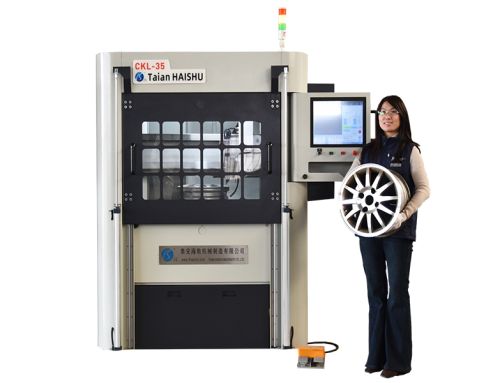
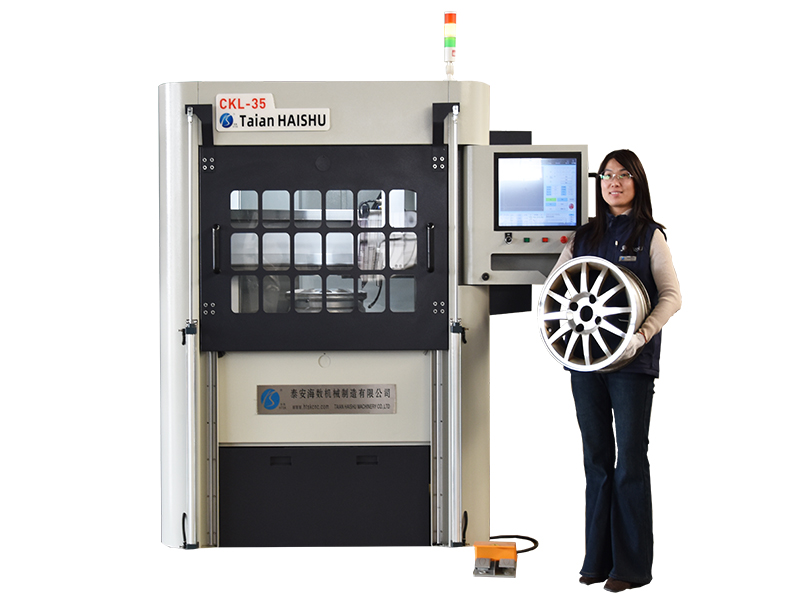
The CKL-35 is the largest wheel hub repair machine in the standard range, with capacity up to 35 inches. The structure is double-column and gantry-style. Three servo motors are used, and all three axes are a 6 N design. Chuck options are 250 mm or 320 mm. Price is typically USD 8,000–12,000. This is the wheel rim repair machine for shops that already turn away large aftermarket and commercial wheels.
The CKL-35P is the upgraded custom version, sold as the Pro or Plus build of the CKL-35. Z-axis travel is 900 mm, so it can repair wheel hubs up to 550 mm in height. Maximum wheel size remains 35 inches. The standard chuck is an enlarged 320 mm three-jaw, with four-jaw or six-jaw optional. Motor power is 5.5 kW. Machine weight is 1.6 tons, so plan the floor and the unloading before the truck arrives. Price is typically USD 9,000–14,000.
The 35P is worth the step up when deep-dish and tall-face wheels are regular work, not a twice-a-year favor. If those wheels are rare, the standard CKL-35 is the more disciplined buy.
3.9 RSM595 and RSM585 straighteners
The RSM595 is a wheel straightening machine, and it should be bought as one. Maximum wheel size is 26 inches. Hydraulic press force is 10 tons. Typical price is USD 1,000–1,800. It can also cut the solder joint on car alloy wheels, which is a useful extra on repaired rims, not a substitute for diamond cutting.
The RSM585 is the manual hydraulic version in the same special straightening lineup. Choose it when the operator wants direct lever control and the volume does not justify the automatic hydraulic cycle. Neither machine is a rim repair machine for face refinishing. They are rim fixing machines for geometry. A bent wheel often has to be straightened before any wheel rim straightening machine conversation turns into a cutting job. Shops searching for an alloy wheel straightening machine should price one of these next to the lathe, not instead of it.
3.10 Who should ask Taian HAISHU for a configuration
Ask when the shop or the investor wants one supplier for a car rim repair machine, a vertical wheel repair lathe, and a hydraulic wheel straightener, with language, voltage, and branding set before shipment. The price bands are low enough that a working shop can model payback in months rather than years, provided the wheels are there.
A planning example, not a promise: eight paid face repairs a week, at a USD 100 contribution after diamond tips and a share of labor, is roughly USD 3,400 a month. A CKL-26Q near the middle of its band is recovered in a little over two months of that volume. A quieter shop at four wheels a week still clears the machine inside a typical season. The RSM595, at well under USD 2,000, is a small add-on if bent work is already being turned away.
The limits are ordinary and should be priced in. Laser is standard; extra detection hardware is not. The portable machine stops at 24 inches. The 35P needs a real floor. Straightening force does not make a cracked rim serviceable. Those limits are why the quote should start with wheel sizes, voltage, and whether spoke-face repair, rim repair, or both are required.


4. Wheel Restore by HBC System
Wheel Restore, part of the Danish HBC group, builds the WR-DCM3 as a purpose-made refinisher rather than a general lathe. It restores diamond-cut wheels up to 30 inches, with or without the tyre fitted. Published figures put the machine at about 450 kg, with a 12-inch industrial touch screen, probing in about a minute, measurement accuracy under 0.013 mm, and single-phase power at 110V or 230V. Average cycle time is quoted around 15 minutes. The enclosure is compact enough for a bay or a van, and the machine is CE marked to turning-machine safety practice.
4.1 Main advantages
The main advantages are tyre-on cutting, a short guided cycle, Danish step-by-step software, profile storage, and the option to run sequential cuts while the technician does another job. Repair logging and a small footprint suit a branded wheel restore machine business that wants a premium process more than the lowest capital cost. Wheel restore machine price sits in a different band from the mid-range CNC lathes in this review, so the buyer is paying for cycle speed and a packaged workflow. It is a refinisher, not a 10-ton press.
5. DCR Systems
DCR Systems designs and builds in Portsmouth. The DCR Pro is a diamond-cut alloy wheel lathe made to work as a static machine or a mobile one. Tyre-on capacity is 14 to 24 inches. With the tyre off, capacity goes to 30 inches. The published footprint is 1004 mm wide, 1760 mm high, and 840 mm deep, at 395 kg. It runs on a 240V 13-amp single-phase supply. The builder quotes a typical 20-inch profile in roughly 30 seconds, then a three-stage sequence of buckle detection, scan, and cut.
5.1 Main advantages
The main advantages are a van-ready design, single-phase power, a very small floor print, and a process that does not assume three-phase or a forklift. DCR also builds preparation and paint equipment around the lathe, so a shop can buy a prepare-repair-paint line from one British maker. That is a strong fit for mobile alloy wheel repair and for body shops that want diamond cutting without a heavy CNC cell. It is less relevant if the requirement is a 35-inch gantry or a high-tonnage rim straightening machine.
6. Lehigh
Lehigh has supplied diamond-cut rim lathes to North American wheel shops for years, and the installed base is the reason buyers still shortlist the brand. The MR-2540 covers a large share of passenger-car sizes. Later models extend the range: the MR-2940 toward 25 inches, the MR-3040 from 13 to 26 inches, and the MR-3660 toward 30 inches on the published capacity list. The machines use a conversational touch-screen control, a digitizing probe, handwheels, Meehanite casting, automatic lubrication, and an enclosed cabinet.
6.1 Main advantages
The main advantages are a long service record in US and Canadian production shops, a control that experienced operators already know, and a model ladder from everyday car wheels to larger SUV and light-truck sizes. Lehigh is a practical alloy wheel repair equipment choice when local parts familiarity and a known operating method matter more than the lowest invoice. Buyers should still confirm the exact inch rating of the model on the quote, because the older 21-inch and newer 26-inch machines are not interchangeable.
7. Comec
Comec, in Porcia, Italy, has built workshop machine tools since 1961. Its wheel line is a straightener, not a diamond-cut face lathe. The RSM240 handles steel, aluminum, and alloy wheels from 13 to 24 inches. A hydraulic cylinder, regulated by a manometer, works with shaped punches. Maximum working pressure is 140 bar and maximum punch force is 3,950 kg. A lathe unit on the same bench cleans remaining edge damage after the rim is brought back to shape. The machine weighs about 350 kg.
7.1 Main advantages
The main advantages are a compact European bench, pressure you can read and limit, a full punch and centering-ring set, and an edge lathe that saves a second setup on lip damage. Spare parts sit inside a long-standing dealer network, which matters for a rim repair equipment purchase that will be used hard. Comec is the right conversation for wheel rim straightening machine buyers who want Italian workshop practice. It is the wrong conversation if the paid job is a full diamond-cut face.
8. Atek Makina
Atek Makina, in Istanbul, has built garage equipment for decades and treats wheel repair as part of a wider tire-shop range. The straightening line includes the Digital, listed for alloy and steel wheels in the 12- to 26-inch class, with digital measurement, joystick control, a folding and sliding lathe, a 1.5 kW hydraulic motor, and a machine weight of 720 kg. The Pangea series extends the press conversation toward 28 inches with digital deflection display. On the cutting side, the Elegance diamond-cut CNC uses Atek’s own software, laser and probe measurement, an enclosed body, and published capacity of 28 inches on the horizontal cut and 22 inches on the vertical cut.
8.1 Main advantages
The main advantages are a straightening range with digital measurement rather than guesswork, joystick control that reduces clumsy ram placement, and a dedicated alloy wheel CNC machine in the Elegance for shops that want face cutting from the same maker. Path optimization and job storage suit repeat wheel styles. Atek is a strong national and export brand for tire businesses that want press and lathe under one service relationship. Confirm power and exact inch rating on the Elegance variant before comparing it with a 26- or 35-inch vertical lathe.
9. Nitromac
Nitromac builds hydraulic rim presses for mixed steel and alloy work. The F24WL is a clear example: 10 to 24 inches, a 5-ton hydraulic pump, an open frame so the ram can come from above, a built-in lathe, LED work lighting, and a kit that includes centering adapters and several straightening heads. Published weight is about 350 kg, with a compact 800 × 1200 × 1600 mm body. Larger NX and RS models in the same family extend toward 28 and 30 inches, and some packages add infrared heating and speed control.
9.1 Main advantages
The main advantages are straightforward hydraulic power, an integrated edge lathe, and accessory sets that cover a wide mix of passenger wheels without a separate CNC purchase. For a tire shop adding a rim straightening machine before it commits to diamond cutting, Nitromac is an accessible wheel straightening machine with a known 5-ton class of force. It should not be quoted as a substitute for a probe-and-diamond alloy wheel lathe when the customer is paying for a machined face.
10. Tryax
Tryax, in the UK, builds the TY30-VS as a vertical diamond-cut lathe on a ribbed cast-iron frame with linear-rail slides. Published cutting range is 14 to 30 inches. The control is a 15-inch multi-touch screen with real-time motion software. A typical 23-inch wheel is quoted as probing in under three minutes. The operation manual lists a Beckhoff control, about 7.6 kW (10 hp) on the spindle, X travel of 508 mm, Z travel of 457 mm, and a machine weight around 2 tonnes. A digitizing probe and profile storage are part of the standard idea of the machine. A smaller single-phase TY23-VSF sits under it for shops that do not need 30 inches.
10.1 Main advantages
The main advantages are structural rigidity, a 30-inch envelope, fast digitizing, and a European motion control rather than a lightly built portable frame. Tryax suits a fixed cell that will cut all day and can accept the weight, the power, and the installation. It is a poor fit for a van. Buyers comparing it with a Taian HAISHU CKL-35 should match inch rating, floor load, and whether they need 35 inches or are fully served at 30.


11. Matching the Purchase to the Work
11.1 Mobile operators and first bays
A mobile operator needs weight under about 500 kg, casters or a van-door design, and single-phase power. The CKL-24Q is built for that brief inside the Taian HAISHU range. The DCR Pro and the WR-DCM3 are the established European alternatives when the buyer wants a specialist mobile refinisher and will pay the premium those machines command. None of the three replaces a hydraulic wheel straightener if the van is also collecting bent rims.
11.2 A general repair shop adding diamond cutting
Most of this work is 17 to 22 inches, with a steady trickle of 24- and 26-inch SUV wheels. The CKL-26Q covers that without overbuying. The CK6160Q is the horizontal alternative if the technician prefers that layout and 24 inches is enough. Lehigh’s 26-inch class and Atek’s Elegance are the comparisons to run if the shop wants a different control language or a local dealer relationship. Budget a separate rim repair machine for bends. The RSM595 is the low-cost automatic option at 26 inches and 10 tons. Comec, Atek’s Digital or Pangea, and Nitromac are the comparisons when the shop’s reputation is structural correction first.
11.3 Large wheels and investors fitting a second site
Investors opening a second site should buy the machine the first site already knows how to run, then change only voltage and language. That is where a configurable OEM Wheel Repair Machine beats a one-off import. If the second site is in a market of deep-dish and oversized wheels, price the CKL-35 or CKL-35P, and compare floor load with the Tryax TY30-VS. If the site is a tire chain that already uses Turkish garage equipment, Atek’s press-plus-Elegance pairing is a coherent alternative.
Vertical Taian HAISHU machines can take both spoke repair and rim repair. State that in the quote so the fixture and jaw set match the work. A machine ordered only for flat faces will disappoint the first time a barrel needs attention.
12. What to Send When You Ask for a Quote
12.1 A short specification beats a catalog request
Send the largest diameter, the tallest face, and whether tyres stay on. Send the real supply voltage and phase. Say whether the machine must move, and through what doorway. Say which languages the operators read. Say whether the job is machine wheel repair of the face, bent-rim correction, or both.
On a Taian HAISHU refinishing quote, also decide detection hardware. Laser is in the base machine. Probe and tool-tip detection are optional hardware with the software already available. Decide the tool holder. The gang holder is the lower-cost, lower-failure choice for a single diamond tool. A turret is justified only if the cycle truly changes tools.
12.2 Price bands in one place
| Model | Class | Capacity | Price band |
| CKL-24Q | Portable vertical refinisher | 24 in, ≤500 kg | USD 4,500–5,500 |
| CK6160Q | Horizontal refinisher | 24 in, 4 kW, 4 N/6 N servos | USD 5,000–7,000 |
| CKL-22Q | Upgraded vertical lathe | 24 or 26 in, 4 kW, 6 N/15 N servos | USD 6,000–8,000 |
| CKL-26Q | Value vertical refinisher | 26 in | USD 7,000–9,000 |
| CKL-35 | Gantry vertical refinisher | 35 in, 250 or 320 mm chuck | USD 8,000–12,000 |
| CKL-35P | Tall-face custom 35-inch | 35 in, 900 mm Z, 5.5 kW, 1.6 t | USD 9,000–14,000 |
| RSM595 | Automatic hydraulic straightener | 26 in, 10 tons | USD 1,000–1,800 |
| RSM585 | Manual hydraulic straightener | Same family, lever control | Quoted with the build |
Those bands are for planning. Final figures follow chuck, voltage, doors, and detection options. European specialist machines such as the WR-DCM3, DCR Pro, and TY30-VS should be quoted locally. Their higher capital cost can still be rational when cycle time, tyre-on work, or a domestic service visit is worth more than the invoice difference.
13. A Practical Close for Shops and Investors
Buy the machine that matches the failure you are paid to fix. A wheel refinishing machine earns on faces and rims that are structurally sound. Wheel straightening equipment earns on bends that inspection says are safe to press. The shops that make money on both own both, and they do not pretend a 5-ton edge lathe is an alloy wheel diamond cutting machine.
Taian HAISHU is the most complete mid-price route through that decision: portable and fixed vertical lathes, a horizontal 24-inch machine, 35-inch gantry machines, and both manual and automatic hydraulic straighteners, on one wheel-specific control. The other seven builders earn their place for specific reasons. Wheel Restore and DCR Systems for compact tyre-on refinishing. Lehigh for a known North American production lathe. Tryax for a heavy 30-inch vertical. Comec, Atek, and Nitromac for serious rim correction, with Atek also offering its own diamond-cut CNC.
If the next step is a purchase rather than another brochure, send wheel sizes, voltage, and whether the bay needs face repair, straightening, or a paired set. A configured quote on a professional wheel repair machine is more useful than a generic price list, and it is the fastest way to see whether the CKL-26Q, the CKL-24Q, the CKL-35, or a straightener beside them is the machine the shop will still be running in three years.