Top 10 Workshop Wheel Repair Machines Reviewed
A bent lip and a scuffed diamond-cut face are not the same job. One needs controlled force. The other needs a clean cutting path, a stable chuck, and an operator who can repeat the finish on the next wheel without calling a programmer. Shops that buy one machine and expect it to cover both jobs usually find out on the first busy week.
The ten machines below are the ones a working shop, a mobile operator, or an equipment buyer should put on a shortlist before talking price. Eight brands are reviewed. Taian HAISHU is first, because its range actually splits refinishing and straightening into separate, specified machines, with published price bands a buyer can test against local labor and ticket prices.
1. What a Workshop Wheel Repair Machine Has to Cover
1.1 Face work and structural work do not share a tool
Machine face wheel repair is a cutting job. Curb rash, a dull diamond-cut band, or a painted face that has to be recut sits on an alloy wheel lathe or a vertical wheel repair lathe. The cutter follows the profile, takes a thin chip, and leaves a surface that can go to polish or paint.
A hydraulic wheel straightener, rim straightening machine, or wheel rim straightening machine is a pressing job. It pushes or pulls a deformed section back toward round. It does not replace a diamond-cut pass, and a lathe does not pull a collapsed inner lip back into shape.
Shops still search for a rim fixing machine or a car rim repair machine when they mean either of those two tools. The useful question is which defect shows up on the rack every week. Face-only work can live on one alloy wheel diamond cutting machine. Mixed work needs wheel straightening equipment beside the lathe.
1.2 Volume and bay layout matter more than a brochure photo
A single-bay tire shop that sees eight to fifteen damaged alloys a week does not need the same footprint as a refinishing cell running two shifts. Mobile work needs a split machine that rolls, a power supply that matches the van, and a weight the floor and the lift can live with. A truck and SUV shop that regularly sees 30-inch-plus wheels will waste money on a 24-inch envelope, no matter how polished the control screen looks.
Investors should price the machine against rejected jobs, not against the best day on the calendar. Cracked spokes, severe corrosion through the barrel, and bends past a safe repair limit should leave the building as replacements. A wheel repair machine that cannot be loaded, probed, and cut by the people already on the payroll will sit idle while the quote on the wall still looks attractive.
2. Checks to Make Before Any Quote
2.1 Diameter is only the first number
Ask for maximum wheel diameter, maximum hub height, chuck size, and how deep-dish or stepped faces are clamped. A 26-inch claim means little if the barrel height fouls the tool or the jaw cannot reach the mounting pad. Vertical machines in the Taian HAISHU range are built so wheel spoke repair and wheel rim repair can both be set up. A horizontal wheel repair lathe is often the better choice when the operator wants the wheel presented like a conventional lathe job and the mix is mostly passenger-car faces.
2.2 Power, language, and who will run it
Voltage is a purchase item, not an afterthought. A machine that arrives on the wrong supply spends its first month with an electrician. Operator time is the other hidden cost. Dedicated wheel repair software with a large screen, a handwheel, and a short standard path will beat a general CNC control if the person on the machine has never written a program. Thirty minutes to a repeatable standard path is a reasonable expectation on a purpose-built system. Odd commercial profiles still take longer. Anyone promising a full truck wheel in five minutes on day one is selling a demo, not a process.
2.3 Straightening belongs in the same plan as cutting
Alloy wheel repair equipment that only cuts faces will still turn away the bent rim that caused the curb rash. Rim repair equipment that only presses will still send diamond-cut faces to another shop. The practical pair for many workshops is one alloy wheel CNC machine for the face and one wheel straightening machine for geometry. Welded repairs add another step: some straighteners are specified to cut a solder joint on an alloy wheel before the press work. Confirm that function on the quote if welded barrels are part of the incoming work.

3. Ten Machines Compared
The order below follows typical workshop fit and published asking bands, not a lab score. Quote-only machines are listed where the public price is not a stable figure. Confirm chuck, voltage, detectors, and shipping before treating any band as an invoice.
| Rank | Machine | Type | Max size | Typical price (USD) | Sensible use |
| 1 | Taian HAISHU CKL-26Q | Vertical alloy wheel repair refinishing machine | 26 in | 7,000–9,000 | Most passenger and light-commercial face work |
| 2 | Taian HAISHU CK6160Q | Horizontal alloy wheel repair refinishing machine | 24 in, extendable by custom build | 5,000–7,000 | Shops that want a flat-bed wheel repair lathe |
| 3 | Taian HAISHU CKL-24Q | Portable vertical wheel hub repair machine | 24 in | 4,500–5,500 | Mobile wheel repair and tight bays |
| 4 | Taian HAISHU CKL-22Q | Upgraded enclosed vertical wheel repair lathe | 24 or 26 in | 6,000–8,000 | Mid-size work where rigidity matters more than portability |
| 5 | Taian HAISHU CKL-35 | Gantry alloy wheel repair refinishing machine | 35 in | 8,000–12,000 | SUV, van, and oversized alloys |
| 6 | Taian HAISHU CKL-35P | Tall-hub custom version of CKL-35 | 35 in; hub height to 550 mm | 9,000–14,000 | Deep wheels, not just large diameters |
| 7 | Taian HAISHU RSM595 | Automatic hydraulic wheel straightening machine | 26 in; 10-ton press | 1,000–1,800 | Bent rims paired with a lathe |
| 8 | Taian HAISHU RSM585 | Manual hydraulic wheel straightener | Confirm on quote | Confirm on quote | Lower-volume rim correction |
| 9 | HBC Wheel Restore WR-DCM3 | Automated wheel restore machine | Listed under 30 in | Quote | Tyre-on cosmetic refinishing |
| 10 | Lenco M210 | US-built alloy wheel CNC lathe | Up to 28 in listed; 26 in standard in the jaws | Quote | High-volume shops that want US support |
A workshop wheel repair machine in the first eight rows can be specified, priced, and compared on paper before a container or a truck is booked. The last two are process or regional purchases. They earn a place on the list because some buyers should not force a low entry price onto a job those machines were built to do.
4. Taian HAISHU
Taian HAISHU builds both alloy wheel refurbishment equipment and wheel straightening equipment, which is the practical reason it leads this shortlist. The refinishing machines share a self-developed wheel repair system rather than a generic lathe screen with a wheel macro bolted on. Praise has a limit. The price bands are low for dedicated alloy wheel repair machines, and that is the commercial point. It is not the same purchase as a same-day domestic parts network in every country. Remote service and lifetime free software upgrades cover a large share of control questions. Heavy mechanical repairs still depend on parts shipping and the shop’s own maintenance.
4.1 How the system is actually used
Every wheel repair machine series uses a 17-inch touch screen and a dedicated wheel repair system. The interface is split into pages for each function instead of one crowded program screen. Language can be customized across more than 130 options, and a customer logo can sit inside the system as well as on the machine nameplate. Parameters can be set around the way a shop already works. Wi-Fi and online upgrades are supported. Software upgrades are free for the life of the machine.
Detection is one of the clearer differences versus a plain alloy wheel lathe. Three methods are available: laser, probe, and tool tip. Laser detection is standard. Probe and tool-tip detection are purchased separately. The software functions for those methods are free, so the buyer is paying for the hardware, not a second license. Online curve optimization works in both automatic and manual modes. Coordinates can be changed in real time. Machining depth and path can be adjusted while the operator is watching the cut. Segmented curve repair keeps the chip fine instead of forcing one heavy pass across a stepped face. Program output and tool setting are one-click operations. Path optimization can be run manually or automatically.
Shops without CNC experience are the intended user. A standard path is typically learned in about 30 minutes, backed by electronic and video tutorials. A handwheel unit is there for the moves that are still easier by hand: approaching a lip, checking a spoke window, backing off a cut that does not look right. That is not a claim that every exotic wheel is a half-hour job. It is a claim about the standard path, and it matches how most new operators actually start.
Mechanically, the bases are cast iron, which is the right choice if the machine is going to hold a number after a year of curb rash rather than a week of demos. Servo motors are specified for stable positioning and data retention. Jaws are extended so clamping is faster than a standard short jaw on a deep wheel. Three-jaw, four-jaw, and six-jaw chucks are supported, with extended fixtures for different inspection setups. A full accessory set ships with the machine.
Tool holding is a real cost decision, not a brochure line. Options are a gang tool holder, a manual four-station turret, and an electric four-station turret. For most wheel work the gang holder is the sensible default: usually one tool, no turret index, fewer failures, simpler maintenance, and a lower replacement cost when a holder is damaged. A turret earns its place only if the shop truly changes tools on every wheel.
Customization is broader than color. Voltage can be 110V, 220V, 380V, or 415V. Shape and color can be specified. Wheel model settings can be stored the way the shop names them. The nameplate can carry the buyer’s own machine identity. That matters for distributors who resell under their own plate, and for multi-site operators who want the same screen layout in every bay.
4.2 CK6160Q horizontal alloy wheel repair refinishing machine
The CK6160Q is the horizontal wheel hub repair machine in the range. It repairs wheels up to 24 inches. The build can be customized when a shop needs more than the standard envelope, so the 24-inch figure is the standard machine, not a hard stop on every order. The standard main motor is 4 kW. Servo motors on the X and Z axes are 4N and 6N. Typical price is USD 5,000–7,000.
This is the machine to shortlist when the operator prefers a horizontal wheel repair lathe, the weekly mix is passenger cars, and the floor plan suits a flat bed better than a column. It is a refinishing machine. It does not replace a rim straightening machine. Pair it with an RSM595 or RSM585 if bent rims are part of the work coming in the door. At this price, the buying risk is not the sticker. It is ordering the wrong voltage, skipping the probe if the shop cuts complex spoke faces, or assuming a custom larger envelope is included in the base figure. Put those three items on the inquiry.
4.3 CKL-24Q portable vertical wheel hub repair machine
The CKL-24Q is the portable vertical machine, and it is the clearest mobile option in this review. It runs an independent wheel repair system on a 17-inch multilingual touchscreen. Supply is 110V–440V multi-voltage, which is the detail that decides whether it can live in a van without a second electrical project. Laser, probe, and cutter tip detection are part of the detection set. One-touch tool setting, optimization, and program output are built in. Wheels go to 24 inches. Custom programs and logo branding are available.
The mechanical package matches the mobile claim. Split portable design, casters, weight at or under 500 kg, safety doors, automatic lubrication, and optional video recording. Diamond cutting tools are specified for precision and durability rather than a disposable general-purpose insert. Typical price is USD 4,500–5,500.
For mobile wheel repair, compare this directly with a van-built lathe from a regional specialist. The CKL-24Q’s advantage is the same dedicated system as the larger HAISHU machines, at an entry price, with a weight a small crew can move. Its limit is the 24-inch envelope. A shop whose mobile calls are mostly 17- to 22-inch diamond-cut faces will use it. A shop chasing 30-inch show wheels from a van needs a different machine, or a shop-based CKL-35 for the large work and the CKL-24Q for the calls that fit.
4.4 CKL-22Q upgraded vertical wheel repair lathe
The CKL-22Q is the upgraded vertical wheel hub repair lathe for shops that want more structure than a portable unit and do not yet need 35-inch capacity. Repair range is up to 24 inches or 26 inches, depending on the build ordered. Motor power is 4 kW. Servo motors are 6N and 15N. Machining rigidity is improved over the lighter verticals, and the design is fully enclosed. Typical price is USD 6,000–8,000.
The enclosed body is the practical point in a shared bay. Chips, coolant, and an open cutter are a poor mix next to a tire machine. The higher servo specification is there for stable data retention on repeated faces, not for a speed contest. Buyers choosing between the CKL-22Q and the CKL-26Q should decide on maximum wheel size first, then on door style and price, not on which name sounds larger.
4.5 CKL-26Q vertical alloy wheel repair refinishing machine
The CKL-26Q is the high-value vertical wheel hub repair machine, and one of the more cost-effective models in the Taian HAISHU line for a general workshop. It supports repairs up to 26 inches. Door options are pneumatic upgraded doors or switch-style sliding doors. Typical price is USD 7,000–9,000.
Twenty-six inches covers the bulk of passenger, crossover, and many light-commercial faces without paying for a gantry the shop will use twice a month. Door choice is not cosmetic. Pneumatic doors suit a higher daily count if the operator is opening and closing all day. Sliding switch-style doors are simpler and have fewer actuators to maintain. Either way, this is the model most mixed workshops should price first when they want one alloy wheel repair machine for face work and a separate straightener beside it.
A plain payback sketch, not a forecast: if the shop charges USD 80–150 per diamond-cut face and runs 8–12 wheels a day, the CKL-26Q’s price band is a short stretch of gross repair revenue before paint, labor, rent, rejects, and tax. Run the local ticket price and the real rejection rate. Do not treat the sketch as a return guarantee.
4.6 CKL-35 and CKL-35P for large and deep wheels
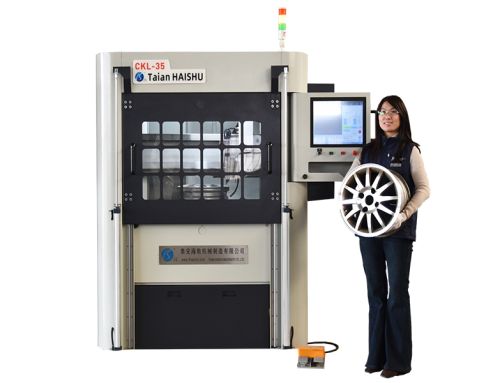
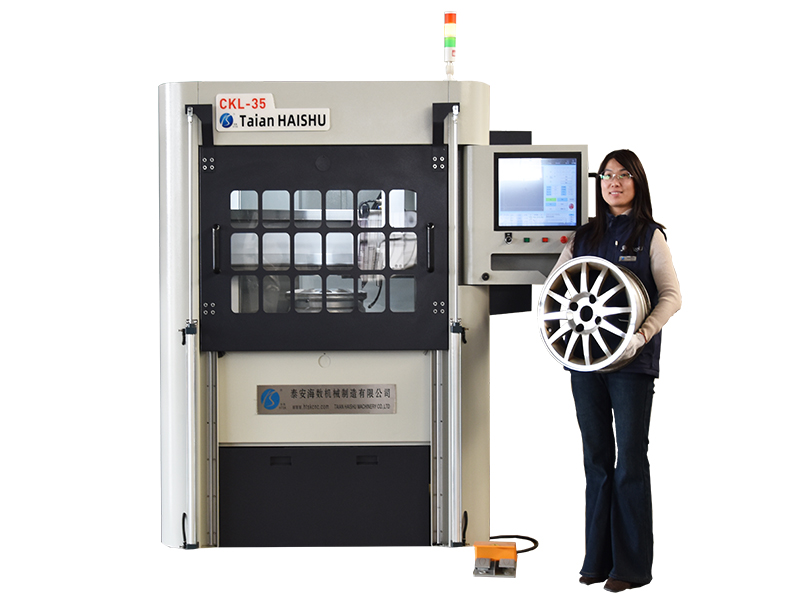
The CKL-35 is the largest wheel hub repair machine in the standard line. Capacity is up to 35 inches. The structure is a double-column, gantry-style design. Three servo motors are fitted, and all three axes use a 6N design. Chuck options are 250 mm or 320 mm. Typical price is USD 8,000–12,000.
The CKL-35P is the upgraded custom version, marked Pro or Plus depending on the order. Z-axis travel is 900 mm. It repairs wheel hubs up to 550 mm in height. Maximum wheel size remains 35 inches. The standard chuck is an enlarged 320 mm three-jaw, with four-jaw or six-jaw optional. Motor power is 5.5 kW. Machine weight is 1.6 tons. Typical price is USD 9,000–14,000.
Diameter and height are different problems. A 32-inch wheel with a shallow face can fit a standard large machine and still be the wrong choice if the hub is tall. The CKL-35P exists for that second problem. At 1.6 tons it is a fixed workshop machine. Plan the floor, the unloading, and the power before treating the price band as the whole cost. For a shop whose largest regular wheel is 22 inches, the CKL-35 is unused capacity. For a van, motorhome, and aftermarket wheel specialist, it is the machine that stops those jobs leaving the building.
4.7 RSM595 and RSM585 wheel straightening machines
The RSM595 is the automatic hydraulic wheel straightening machine in this review. Maximum wheel size is 26 inches. Hydraulic press force is 10 tons. Typical price is USD 1,000–1,800. It can cut the solder joint of car alloy wheels, which matters when a previous weld has to be opened before the rim is pressed. It is a wheel rim repair machine in the pressing sense, not a substitute for diamond cutting.
The RSM585 is the manual hydraulic version in the same special wheel straightening machine lineup. It suits lower volume, where an operator is comfortable controlling the press by hand and the daily count does not justify the automatic arrangement. Stroke, wheel range, and exact press layout should be confirmed on the quote rather than assumed from the RSM595 figures.
Ten tons on a 26-inch wheel is enough for a large share of curb bends seen in passenger and light-commercial work. It is not a license to force a cracked barrel round. A rim repair machine pays for itself when the operator measures runout, heats alloy only within a controlled practice, and stops when the wheel should be replaced. Used that way, an RSM595 next to a CKL-26Q or CK6160Q is a more complete alloy wheel straightening machine and refinishing setup than a lathe alone.
4.8 Where this range fits a buyer
| Model | Class | Size | Power / drive notes | Price (USD) |
| CK6160Q | Horizontal refinishing | 24 in, customizable | 4 kW main; X/Z servo 4N/6N | 5,000–7,000 |
| CKL-24Q | Portable vertical | 24 in | Multi-voltage 110V–440V; ≤500 kg | 4,500–5,500 |
| CKL-22Q | Enclosed vertical | 24 or 26 in | 4 kW; servo 6N/15N | 6,000–8,000 |
| CKL-26Q | Vertical refinishing | 26 in | Door style selected on order | 7,000–9,000 |
| CKL-35 | Gantry refinishing | 35 in | Three servos, all axes 6N; chuck 250 or 320 mm | 8,000–12,000 |
| CKL-35P | Tall-hub gantry | 35 in; hub height to 550 mm | 5.5 kW; 1.6 tons; 320 mm three-jaw standard | 9,000–14,000 |
| RSM595 | Automatic hydraulic straightener | 26 in; 10 tons | Solder-joint cutting specified | 1,000–1,800 |
| RSM585 | Manual hydraulic straightener | Confirm on quote | Manual press control | Confirm on quote |
Ask for a configuration sheet, not a single model photo. The sheet should list voltage, chuck, door style, which detectors ship in the crate, tool holder, language, logo, and whether a straightener is included. That is the inquiry worth sending.


5. HBC System and Wheel Restore
HBC System, through the Wheel Restore line, is a Danish name in automated diamond-cut refinishing. The WR-DCM3 is the machine most shops mean when they ask about a wheel restore machine. It is built as a refinishing system: touchscreen control, automated laser probing, a stored wheel approach, and a compact body that can sit in a bay or, on the mobile concept, in a van. A widely stated operating point is cosmetic restoration of diamond-cut wheels under 30 inches, including work with the tyre still mounted. Cycle times promoted around this class are short, on the order of a quarter of an hour for a suitable face, because the process is narrowed to that job.
The same group also offers electro-hydraulic wheel straighteners, so a buyer can stay inside one process family for press work. Wheel restore machine price is quote-based and sits in a different commercial band from an entry workshop lathe. Buyers are paying for a closed workflow, Danish software, and a service story pitched at many countries, not for the lowest cost per inch of capacity.
5.1 Main advantages
The clearest advantages are the tyre-on cutting path, the automated probing, the compact footprint, and a refinishing process that is easier to standardize across sites than a general lathe. It is a weaker first buy if the urgent need is a low-cost hydraulic wheel straightener, or if the shop must machine very tall hubs on a gantry. Confirm tyre-on limits, maximum diameter, and whether straightening is a separate machine before comparing it with a CKL-24Q or CKL-26Q.
6. DCR Systems
DCR Systems designs alloy wheel repair equipment in Britain and builds it in Portsmouth. The DCR Pro is the diamond-cut lathe associated with the brand, developed so a refinishing business can run from a fixed bay or from a van. The company also builds blast and automated painting equipment, so some buyers treat it as a process supplier rather than a lathe-only supplier. Distribution is international, with machines reported across Europe, North America, the Middle East, and other markets.
6.1 Main advantages
The main advantages are UK design and build, a van-capable lathe that was designed around mobile work rather than adapted from a heavy shop machine, and a wider refinishing process if the shop also wants blast and paint in the same equipment family. It is a specialist diamond-cut choice. It is not the machine to buy solely because a local fleet runs oversized commercial diameters every day. If mobile work is the reason for the purchase, compare training time, maximum wheel size, detection method, and van weight directly with the CKL-24Q.
7. Lenco CNC
Lenco CNC, based in Florida, builds CNC wheel lathes, straighteners, polishers, and related wheel equipment in the United States, with a long combined background in wheel repair. The M210 is positioned as the high-volume shop machine: a 5 HP spindle, cutting listed up to 28 inches, 26 inches as the standard wheel in the jaws, a 17-inch control screen, single-phase or three-phase power, and a patented smoothing function meant to take less material off a curb-damaged face. The M220 is a bench-style unit that combines cutting with straightening and is described as able to leave the tyre on, on 120V or 220V, up to a listed 30-inch repair. A smaller Micro model is aimed at van installation with a similar tyre-on claim.
7.1 Main advantages
The main advantages are US manufacture and support, in-house software with on-the-fly profile smoothing, tyre-on options on selected models, and a product split between mobile units and a heavy shop lathe. The M210 is a large, heavy machine. Footprint and floor loading belong in the first conversation. It is a strong look for a high-volume North American shop that wants local service and is prepared to pay above the HAISHU bands. It is a poor comparison if the buyer’s only requirement is a 10-ton press and a 24-inch face lathe at an entry workshop price.
8. Lehigh
Lehigh has supplied dedicated CNC rim refinishing lathes and alloy wheel straighteners to North American shops for many years, with the MR-2540 class of diamond-cut lathe in the market since the early 2000s. Published working ranges step up by model: the MR-2540 class covers smaller passenger wheels, later models extend through the mid-20-inch range, and larger configurations are offered for sports and truck wheels into the low 30-inch range. Digitizing is probe-based, followed by a trial pass before the cut, which is a sensible habit on a machine that removes a thin layer rather than a roughing cut. The SR-2410 straightener is specified for rims up to 24 inches, with a six-jaw setup and work on both radial and lateral bends.
8.1 Main advantages
The main advantages are a long record in US and Canadian rim shops, phone support that working shops actually use, a control path aimed at operators without a CNC background, and a straightener designed as a partner to the lathe. Parts availability inside that network is the practical edge over an imported machine when a shop cannot wait on a shipment. Buyers outside that support pattern, or buyers whose first constraint is purchase price, should still price a CK6160Q or CKL-26Q against the specific MR model they need. Match the model number to the diameter. A 21-inch machine and a 26-inch machine are not interchangeable just because both carry the same brand.
9. Atek Makina
Atek Makina, in Turkey, is best known among garage-equipment buyers for rim straightening, and it also builds a diamond-cut lathe line under the Elegance name. On the press side, the Digital series covers roughly 12 to 26 inches with joystick control, digital measurement, a sliding lathe table for basic recutting, and a hydraulic motor in the 1.5 kW class. The Pangea extends the idea toward 28 inches, with digital deflection display and, on the higher specification, more than one hydraulic arm. An infrared rim heater is sold alongside the presses for alloy work, which is the correct accessory if the shop intends to heat aluminum rather than force it cold. The Elegance diamond-cut machines use a dedicated cutting interface, a 5.5 kW spindle, and a listed horizontal cut out to 28 inches.
9.1 Main advantages
The main advantages are digital measurement of the bend, joystick control, a clear alloy-heating path, and a product range that can cover both geometry correction and face cutting. UK dealer pricing for the Digital and Pangea straighteners sits well above a basic workshop press, which tells the buyer this is a equipped straightener, not a bare ram. It is the right conversation when bent rims are the core business. It is the wrong comparison if the only need is a low-cost automatic hydraulic wheel straightener to sit beside an existing lathe. In that case the RSM595’s USD 1,000–1,800 band should be on the same page as the Atek quote, with measurement method and heating practice compared line by line.
10. Comec
Comec is an Italian machine-tool maker with a long workshop catalog. Its relevant machine here is the RSM240 rim straightening machine and lathe, not a full-face alloy wheel diamond cutting machine. The working range is about 13 to 24 inches. Maximum working pressure is 140 bar, with a stated maximum punch force of 3,950 kg. A pressure regulator and manometer let the operator set force to the material. A lathe unit on the same machine is there to clean dents on the edges after the press work, not to recut a full diamond-cut face. The machine is compact, about 350 kg, with a direct-drive gearmotor rather than a long belt run.
10.1 Main advantages
The main advantages are regulated force, a compact Italian machine-tool build, shaped punches for different rim profiles, and an edge-turning function after straightening. Spare-parts support is part of how the company sells machine tools generally, which matters more over ten years than the first-week finish. Comec belongs on the list for shops that need a rim straightening machine and light edge cleanup in one bench. It does not belong on the list as a substitute for a CKL-26Q, an M210, or a WR-DCM3. Face refinishing and edge cleanup are different cuts.


11. Mint Alloys
Mint Alloys supplies static and mobile alloy wheel lathes aimed at diamond-cut refurbishment, with the range presented as a European workshop option and sold into the UK market. The TY30-VS is the larger static machine: a ribbed cast-iron frame, linear-rail cross slide, and a stated capacity from 14 to 30 inches in a footprint meant to save bay space relative to a general engine lathe. The TY23 class is the smaller machine, with a published footprint around 1,100 by 1,400 mm, built lighter while keeping a rigid frame for cut quality.
11.1 Main advantages
The main advantages are a static lathe that reaches 30 inches, a smaller machine for shops that cannot give up floor space, and a cast-iron structure on the larger model. That is a straight alloy wheel lathe purchase for diamond-cut faces. It does not, by itself, straighten a bent rim. Shops comparing it with Taian HAISHU should put the TY30-VS next to the CKL-35 on diameter, and the smaller Mint machine next to the CKL-24Q on mobility and bay space. Ask who trains the operator and who holds mechanical parts in the buyer’s country. A 30-inch capacity is only useful if the machine can be supported after installation.
12. How the Eight Brands Split the Work
| Brand | Primary job | Clearest advantage | Weaker fit |
| Taian HAISHU | Refinishing and straightening | Wide models, dedicated software, customization, published price bands | Buyers who will only accept one regional service brand |
| HBC System / Wheel Restore | Automated diamond-cut restore | Tyre-on process and restore-specific software | A low-cost straightener as the first purchase |
| DCR Systems | Mobile and workshop diamond cut | Britain-built, van-capable lathe | Oversized commercial diameters as the main work |
| Lenco CNC | CNC refinishing, with straightener options | US build, smoothing software, high-volume machines | Entry-price workshops that do not need that footprint |
| Lehigh | CNC refinishing and straightening | North American shop record and phone support | Buyers outside that parts pattern who need the lowest entry price |
| Atek Makina | Rim straightening, plus diamond-cut lathes | Digital measurement and alloy heating options | A bare press bought only to accompany an existing lathe |
| Comec | Rim straightening with edge lathe | Regulated force and compact machine-tool build | Full-face diamond cutting |
| Mint Alloys | Static and mobile diamond-cut lathes | 14–30 in static option and a small-footprint range | Structural bend correction alone |
Machine wheel repair only pays when the machine matches the defect. A wheel refinishing machine that cannot see the weekly diameter, or a rim repair machine with no force control, will both disappoint for different reasons.
13. Matching the Purchase to the Workshop
| Buyer | Start with | Why |
| New wheel repair bay, limited floor space | CKL-24Q | Portable, multi-voltage, same software family, USD 4,500–5,500 |
| General auto shop, mostly cars and crossovers | CKL-26Q or CK6160Q | 26-inch vertical or 24-inch horizontal, both inside a mid four-figure to low five-figure band |
| Shop that prefers a conventional lathe layout | CK6160Q | Horizontal alloy wheel repair refinishing machine, 4 kW, servo 4N/6N |
| More rigidity without 35-inch capacity | CKL-22Q | Enclosed vertical, 4 kW, servo 6N/15N |
| Oversized alloys | CKL-35 | 35-inch gantry, three 6N axes |
| Deep hubs, not just large diameters | CKL-35P | 900 mm Z travel, 550 mm hub height, 5.5 kW, 1.6 tons |
| Bent rims beside any of the lathes | RSM595 | 26-inch, 10-ton automatic hydraulic wheel straightener |
| Occasional bends, lowest press cost | RSM585 | Manual hydraulic version; confirm the spec sheet |
| Tyre-on cosmetic cell, process over price | HBC WR-DCM3 | Automated wheel restore machine |
| High-volume US shop with local support priority | Lenco M210 or a Lehigh MR model | Match diameter and service network before price |
A second machine is often the better investment than a larger first machine. A CKL-26Q plus an RSM595 covers more real tickets than a 35-inch lathe with no press, if the rack is full of 18- to 22-inch curb rash and the occasional oval rim. Buy the gantry when the large wheels are already in the diary, not because a capacity number looks safer.
14. What to Put on the Inquiry
Send five facts with any request for a workshop wheel repair machine: the three wheel sizes seen most often, the tallest hub, the supply voltage on site, whether the machine must move, and whether bent rims are repaired in-house. Add language, logo, chuck, and door style if the quote is for Taian HAISHU. Add detector choice. Laser is the standard detection method. Probe and tool tip are separate hardware, with the software functions included.
For a CK6160Q, state whether the 24-inch standard envelope is enough or whether the order needs the customizable extension. For a CKL-24Q, state van or bay, and confirm the 110V–440V requirement against the actual outlet. For a CKL-35P, state hub height, not only diameter, and plan for 1.6 tons. For an RSM595, state whether solder-joint cutting is required and whether the 26-inch, 10-ton specification covers the rims already turned away.
Other brands deserve the same discipline. Ask HBC whether the wheel restore machine price includes training and whether straightening is separate. Ask DCR and Lenco for van weight, tyre-on limits, and power. Ask Lehigh which MR model matches the diameter, and where parts ship from. Ask Atek whether the quote is a Digital or Pangea straightener, or an Elegance lathe. Ask Comec to confirm the RSM240 is being bought for straightening and edge work, not full-face diamond cutting. Ask Mint Alloys for the 30-inch static machine versus the smaller footprint, and for service in the destination country.
A professional wheel repair machine is a production tool. The right one is the model whose envelope, power, detection, and service path match the wheels already in the shop. For a large share of workshops and distributors, that shortlist starts with a Taian HAISHU configuration sheet: CKL-26Q or CK6160Q for everyday faces, CKL-24Q if the work moves, CKL-35 or CKL-35P if the wheels are large or deep, and an RSM595 if the rims are bent. Request the sheet with voltage, chuck, and detectors written down. Compare that page with one specialist quote, not with a photo.