Top Rated Garage Wheel Repair Machines for Garages
A garage wheel repair machine earns floor space only when diameter, damage type, and weekly volume line up. Curb rash on a diamond-cut face and a buckle in the inner lip are different jobs. One needs a lathe. The other needs a press. Shops that buy one tool and expect it to do both usually lose the second job to a specialist, or worse, scrap a rim that should have been saved.
The eight brands below are reviewed as equipment a working bay can actually run. Taian HAISHU is covered first and in more detail, because the range includes both refinishing lathes and straightening machines across a wide size and price band. The other seven are established names in diamond-cut refinishing or hydraulic rim correction. Each has a clear strength. None of them is the right buy for every ticket.
1. Match the Machine to the Damage
1.1 Face refinishing
Diamond-cut alloys fail in a predictable way. The clear coat breaks, the machined face clouds, and a kerb leaves a bright scar across the spokes. Repair means scanning the profile, taking a controlled skim with a diamond tool, and leaving enough section for lacquer. That is machine face wheel repair. A hydraulic press does not restore that surface.
An alloy wheel lathe, wheel repair lathe, or alloy wheel diamond cutting machine is the correct class of tool. Vertical machines in this category are often asked to handle both wheel spoke repair and wheel rim repair on the same setup, which matters when the damage crosses from the face onto the outer lip.
1.2 Rim correction
A bent flange, a flat spot, or a wheel that will not hold balance after a pothole is a geometry problem. The right tool is a wheel straightening machine, also sold as a rim straightening machine, wheel rim straightening machine, or hydraulic wheel straightener. Force is applied through a punch or arm, the rim is rotated, and runout is checked again. A lathe cannot pull a collapsed lip back into round. Trying to “cut it true” only removes metal from a rim that is still bent.
1.3 Jobs that need both tools
Many paid tickets need both. Straighten first, then refinish the face if the customer wants the factory look back. Welded cracks add a third step: dress the joint, then machine only if the face requires it. A rim fixing machine that can cut a solder joint is useful prep. It is not a substitute for an alloy wheel CNC machine.
| Damage | Tool that does the work | What the other tool will not do |
| Clouded or scarred diamond-cut face | Wheel refinishing machine / alloy wheel lathe | A press will not restore the machined face |
| Buckle, flat spot, lateral or radial runout | Wheel straightening equipment | A lathe will not pull the rim round |
| Welded or soldered joint that must be dressed | Straightener with a joint-cutting function, then a lathe if the face needs it | Joint cutting is not diamond cutting |
| Tall hub or deep offset | Vertical lathe with enough Z travel | A diameter rating alone does not cover hub height |
2. Numbers That Should Be on the Quote
Price a garage wheel repair machine after that split is clear. A low machine price with the wrong chuck, the wrong voltage, or no detection hardware is not a saving. It is a second purchase.
2.1 Size, chuck, and travel
Ask for maximum wheel diameter, maximum hub height, and chuck diameter as three separate figures. A 26-inch claim means little if the wheel is deep and the jaws cannot reach. Three-jaw chucks cover most passenger alloys. Four-jaw and six-jaw chucks matter when the center bore or the bolt pattern will not sit true in a three-jaw. Extended jaws shorten clamping time on everyday wheels. Shops that inspect odd commercial rims should also ask whether extended fixtures are part of the package or a later extra.
2.2 Power and installation
Main motor power tells you whether the cut stays stable on a wide SUV face. Servo size on each axis tells you whether position holds when the tool enters a spoke pocket. Voltage is a site question, not a catalog footnote. Export bays, older buildings, and mobile vans may be on 110V or 220V single phase. Fixed industrial bays are often 380V or 415V three phase. A machine that cannot be built for the supply you have is the wrong machine, regardless of the finish it produces in the factory video.
Floor space and weight decide whether the unit stays in one bay or moves. A split frame on casters is a different installation from a 1.6-ton gantry.
2.3 Software and training
General CNC controls can cut a wheel. They are slow to learn, and most wheel technicians are not programmers. Dedicated wheel software, a large touchscreen, and a short path from scan to program are what keep a wheel repair machine earning on day one. Confirm how profiles are stored, whether depth can be changed while the cut is running, and who updates the software after installation.

3. Taian HAISHU
3.1 Product family and buyer fit
Taian HAISHU treats the garage wheel repair machine as a dedicated family, with refinishing lathes and hydraulic straighteners specified as separate tools. That split is the practical reason shops and distributors keep the name on a shortlist. A buyer can start with a portable vertical lathe, add a straightener, and later move to a larger vertical frame without changing the operating logic.
The range is not trying to be a European tyre-on cosmetic cell, and it is not a press-only line. It is alloy wheel repair equipment for bays that want diamond cutting and, when the ticket requires it, rim correction, at published price bands that independent shops can actually fund. Praise past that point should follow the spec sheet. A passenger-car shop does not need a 35-inch gantry. A van operator may prefer a lighter purpose-built cosmetic lathe if straightening will be sent out. Those are real limits, not footnotes.
3.2 Control system and detection
Every wheel repair machine in the series uses a 17-inch touchscreen and a fully self-developed wheel repair system, not a general lathe control with a wheel screen pasted on. The interface is built as a one-stop page set: each function has its own page, parameters can be set around how a technician actually works, and the path from detection to program is short. Shops that have put a non-CNC technician on the machine commonly report that standard operation is learned in about 30 minutes. That figure is for learning the controls, not for every odd commercial wheel. Unusual profiles still need judgment. Electronic and video tutorials cover the standard path so a second shift is not waiting on a factory visit.
Language and branding are built in rather than bolted on. The system can be customized in more than 130 languages, a customer logo can sit inside the software, and the machine nameplate can be made to match a distributor or a shop brand. Wheel model settings can be stored to the user’s own list. Wi-Fi and online upgrades are supported, software upgrades are lifetime and free, and remote service is part of the support model. For an investor placing machines in more than one country, that combination matters more than a decorative cabinet.
Detection is three-way: laser, probe, and tool tip. Laser detection is standard. Probe and tool-tip hardware are purchased separately. The software functions for those methods are included, so a shop can add the tool later without buying a software tier. In practice, laser covers most face scans. A probe is the fallback when the surface or the spoke shape does not suit a laser pass. Tool-tip detection is there for setting the cutter without a long manual routine.
Curve work is where the system earns its keep on real wheels. Optimization runs online in both automatic and manual modes. Coordinates can be edited in real time. Depth and path can be adjusted while the operator is watching the cut, which is how a technician saves a wheel that is thinner on one spoke than the scan suggested. Segmented curve repair keeps the cut in short sections and leaves fine chips instead of a heavy continuous ribbon. Program output and tool setting are both one-click operations. Path optimization can be left automatic or taken over manually. A handwheel sits alongside the screen for operators who want a physical feel when they nudge a start point.
3.3 Mechanical choices that affect uptime
The base is cast iron, specified for rigidity rather than for a light shipping weight. Servo motors are high-precision units chosen so position data stays stable from one wheel to the next. That stability is what makes stored profiles useful. If the machine drifts, a saved program is just a confident way to scrap a rim.
Tool holding is a choice, and the sensible default for most wheel work is a gang tool holder. Wheel refinishing usually runs one diamond tool. A turret that never needs to index is one less failure point, easier to maintain, and cheaper to replace. A manual four-station turret or an electric four-station turret is available when a shop genuinely changes tools during the cycle. Buying a turret “because CNC machines have turrets” adds cost without adding finished wheels.
Clamping is built around an extended jaw so everyday alloys go on quickly. Three-jaw, four-jaw, and six-jaw chucks are supported. Self-designed extended fixtures cover inspection setups that a standard jaw set will not hold. The accessory set is supplied as a working kit, not as a list of items to buy after the machine lands. Voltage can be built for 110V, 220V, 380V, or 415V. Appearance, including shape and color, can be specified. Vertical machines in the range support both spoke repair and rim repair, which is the difference between a face-only skim and a wheel that is damaged out to the lip.
Diamond cutting tools are the consumable that decides surface quality. They are part of the conversation at order stage, not an afterthought when the first dull face comes back cloudy.
3.4 CK6160Q and CKL-24Q
The CK6160Q is the horizontal alloy wheel repair refinishing machine in the range. It repairs wheels up to 24 inches, and the build can be customized when a shop has a repeat size just outside that figure. Typical price is USD 5,000–7,000. The standard main motor is 4kW. X and Z axis servo motors are 4N/6N. Horizontal layout suits shops that already think in flat-bed lathe terms and want a straightforward wheel rim repair machine for passenger-car faces. It is not the model to pick for mobile work, and it is not the model for 30-inch commercial alloys.
The CKL-24Q is the portable vertical wheel hub repair machine, and it is the unit to price first if the business is mobile wheel repair or the bay is tight. It runs an independent wheel repair system on a 17-inch multilingual touchscreen. Supply is 110V–440V multi-voltage, which is the practical answer for vans and for export sites that do not share one industrial feed. Laser, probe, and cutter-tip detection are supported on this model, with the same supply rule as the rest of the series: laser is the standard package, the other detection tools are separate purchases, and the software side is included. One-touch tool setting, optimization, and program output are standard. Capacity is wheels up to 24 inches. Custom programs and logo branding are available for dealers who want the screen and the job files to carry their own name.
The mechanical package is what makes the portability claim real. The design splits for transport, it sits on casters, and weight is held at or below 500 kg. Safety doors, automatic lubrication, and optional video recording are part of the specification. Diamond cutting tools are specified for precision and tool life, not as a generic insert. Typical price is USD 4,500–5,500. That band is an entry point for a professional vertical wheel repair lathe, not a hobby lathe. Confirm detection hardware and any branding work on the quote so the invoice matches the machine you think you ordered.
3.5 CKL-22Q, CKL-26Q, CKL-35, and CKL-35P
The CKL-22Q is the upgraded vertical wheel hub repair lathe for shops that want more rigidity than a portable frame and do not yet need 26- or 35-inch capacity. Repair range is up to 24 inches or 26 inches, depending on the build. Motor power is 4kW. Servo motors are 6N/15N. Machining rigidity is improved over the lighter verticals, and the design is fully enclosed. Typical price is USD 6,000–8,000. It is a sensible fixed-bay alloy wheel repair machine when most work is passenger and light SUV, and when enclosure and stiffness matter more than moving the machine between sites.
The CKL-26Q is the high-value vertical wheel hub repair machine, and it is one of the more cost-effective models in the Taian HAISHU list for shops whose real mix tops out at 26 inches. Door options are practical: pneumatic upgraded doors, or switch-style sliding doors. Pick the door that matches how wheels are loaded, not the one that looks better in a photo. Typical price is USD 7,000–9,000. For a large share of independent bays, 26 inches covers the SUV and crossover faces that actually arrive, without paying for gantry structure that will sit idle.
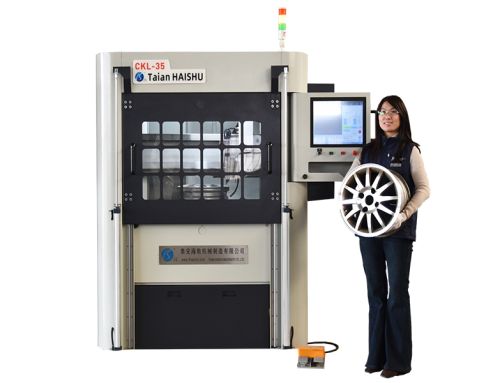
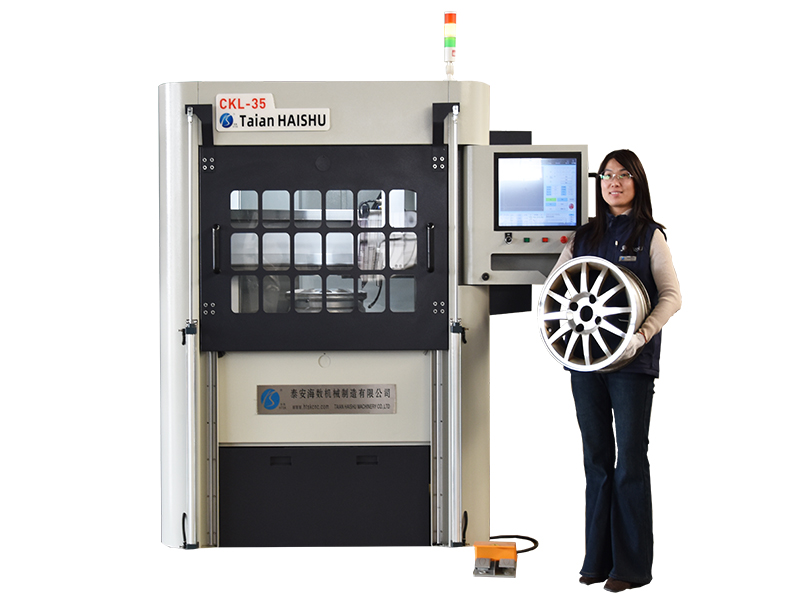
The CKL-35 is the largest wheel hub repair machine in the standard lineup. Capacity is up to 35 inches. The structure is double-column and gantry-style, which is the correct conversation once wheel weight and diameter start to twist a light frame. Three servo motors are fitted, and all three axes use a 6N design. Chuck options are 250 mm or 320 mm. Typical price is USD 8,000–12,000. This is the alloy wheel CNC machine to specify when vans, large SUVs, and oversized alloys are a weekly fact, not a once-a-year photo.
The CKL-35P is the upgraded custom version of the CKL-35, sold as a Pro/Plus build for tall hubs rather than for diameter alone. Z-axis travel is 900 mm. It repairs wheel hubs up to 550 mm in height. Maximum wheel size remains 35 inches. The standard chuck is an enlarged 320 mm three-jaw, with four-jaw or six-jaw optional. Motor power is 5.5kW. Machine weight is 1.6 tons. Typical price is USD 9,000–14,000. Buy this when deep offsets and tall centers are the reason jobs are being turned away. Do not buy it only because 35 inches sounds safer than 26.
3.6 RSM595 and RSM585
Refinishing and straightening stay separate, which is the correct engineering choice. The RSM595 is the automatic hydraulic wheel straightening machine. Maximum wheel size is 26 inches. Hydraulic press force is 10 tons. Typical price is USD 1,000–1,800. It can cut the solder joint of car alloy wheels, which is a prep step after a weld, not a diamond-cut finish. Pair it with a lathe when the customer wants the face restored. Use it alone when the paid job is runout, not appearance.
The RSM585 is the manual hydraulic version in the same special wheel straightening machine lineup. It suits lower volume, where an operator is content to control the stroke by hand and the ticket count does not justify the automatic unit. Confirm jaw set, punch set, and voltage on the quote. A straightener without the punches that match your rim profiles is a frame, not a rim repair machine.
Treat each published range as a garage wheel repair machine budget, then lock chuck, detection hardware, voltage, and tooling on the written quote. The bands above are typical selling ranges in USD, not a fixed invoice. Options move the number. A bare comparison that ignores those options will pick the wrong model.
4. HBC System
4.1 Main advantages
HBC System, through its Wheel Restore line, is a Danish builder focused on automated diamond-cut refinishing rather than on a general machine-tool catalog. The WR-DCM3 wheel restore machine is purpose-built for alloy faces. Company material puts capacity under 30 inches, with laser probing, in-house software, and a touchscreen process that stores wheel profiles. The machine is specified to cut with the tyre on or off, which saves a demount on cosmetic tickets and suits seasonal tyre-storage work. The format is compact, movable on a pallet jack, able to run from single-phase supply, and light enough for a suitable van install. CE compliance and a companion electro-hydraulic straightener, the WM-300, plus blast and paint equipment, let a shop buy a cosmetic line from one maker.
The main advantage is a fast, tyre-on cosmetic workflow with Danish software and a small footprint. It is a strong fit for refurbishment centers that sell appearance, not for a buyer whose first need is a low-cost rim repair equipment package for badly buckled commercial rims. A wheel restore machine price in this class should be read against cycle time and tyre-on labor saved, not against an entry hydraulic press.
5. DCR Systems
5.1 Main advantages
DCR Systems designs and builds its diamond-cut alloy wheel lathe in Portsmouth, Britain. The DCR Pro is aimed only at refinishing, not at structural straightening. Published capability is tyre-on cutting up to 24 inches and tyre-off cutting up to 30 inches. The machine is compact, runs on single-phase supply, and was laid out so it can live in a workshop or in a van. Laser profiling and a step-by-step touchscreen are the operating core. A published weight figure of about 390 kg is the number to put next to doorway and tail-lift limits. Companion kit for lifting, blasting, and painting exists for shops that want the cosmetic process in one place.
The main advantage is a Britain-built, van-capable diamond-cut lathe with tyre-on work up to 24 inches and a short operator path. It is the wrong shortlist item if the business is bent-rim correction or oversized commercial diameters that need a heavy gantry. Compare training time, maximum size, and detection method directly with a portable vertical lathe if mobile face work is the reason for the purchase.
6. Lehigh
6.1 Main advantages
Lehigh has a long record supplying North American rim shops with dedicated CNC refinishing lathes and a separate alloy wheel straightening machine. The MR lathe series is conversational rather than G-code based, which is the point for technicians who have never run a CNC. Published working ranges run from passenger sizes on the earlier MR-2540, through about 25 inches on the MR-2940 and about 26 inches on the MR-3040, with larger frames aimed at truck wheels. The SR-2410 straightener is specified for rims up to 24 inches and about 10 inches of depth, with a six-jaw chuck and a heavy tubular frame. Shops in the United States and Canada repeatedly cite phone support and local parts as the reason the machines stay in production bays.
The main advantage is a proven refinishing-plus-straightening pair with conversational controls and after-sales access in the North American shop network. Buyers outside that parts network should price support response before they price the iron. Lehigh is rim repair equipment for established wheel businesses, not a lightweight mobile cosmetic unit.
7. COMEC
7.1 Main advantages
COMEC is an Italian machine-tool maker, established in 1961, with a long automotive reconditioning catalog and ISO 9001 certification. In this category the relevant product is the RSM240, a rim straightening machine with an integrated lathe unit. It is built for steel, aluminium, and alloy wheels up to 24 inches. A hydraulic cylinder with pressure regulation and a manometer lets the operator set force to the material. Shaped punches match different rim profiles. After the rim is brought back, the lathe unit dresses edge dents. The package is compact relative to a full CNC cell.
The main advantage is regulated hydraulic correction plus light edge machining in one Italian-built station. It suits tire shops and body shops that straighten often and only need to clean a lip afterward. It is not a high-volume alloy wheel diamond cutting machine, and it should not be quoted as one. Shops whose reputation rests on a factory diamond-cut face still need a dedicated lathe.


8. ATEK MAKINA
8.1 Main advantages
ATEK MAKINA, based in Turkey, is widely distributed as a specialist in hydraulic rim repair equipment, with CE-marked machines and a patent record in wheel service. The Pangea professional series covers alloy and steel wheels from 12 to 28 inches. Digital measurement shows deflection instead of relying on a dial indicator alone. Control is by joystick, with electronic speed control published at 5 to 98 rpm. The maker lists a 1.5 kW hydraulic motor, a 1.1 kW movement motor, a machine weight of about 940 kg, and a folding or sliding lathe for basic re-cutting. Access around the wheel is a stated design point, including multi-angle tooling. The Digital series, in the 10 to 26 inch class, is specified to pull as well as push, which matters on damage that a one-direction ram only half-corrects. Optional infrared heating is offered for aluminum work where the shop wants the rim warm before force is applied.
The main advantage is digital, joystick-controlled straightening across a wide diameter band, with a basic lathe for edge work and a pull function on the Digital models. The integrated lathe is for re-cutting and cleanup. It does not replace a dedicated wheel refinishing machine when the product being sold is a full diamond-cut face. Budget accordingly. This is premium workshop wheel straightening equipment, not an entry press.
9. NITROMAC
9.1 Main advantages
NITROMAC, based in Izmir, Turkey, builds hydraulic wheel straightening and polishing equipment for automotive service shops. Models in the F24WL class are aimed at alloy and steel rims rather than at CNC face production. The line sits with other service-shop machines, which is useful when a tire business wants straightening and polishing capacity without standing up a separate machining department.
The main advantage is a service-shop focus: hydraulic correction and polishing for the rims a tire bay already sees, from a maker whose catalog is built around that work. It is a practical car rim repair machine path when deformation and surface prep are the paid jobs. It is not the brand to shortlist first for stored wheel profiles, segmented diamond-cut programs, or large-diameter gantry machining. Confirm diameter, punch set, and whether a lathe unit is included before comparing it with a CNC wheel repair lathe.
10. Inovatec Machinery
10.1 Main advantages
Inovatec Machinery supplies hydraulic alloy rim straightening machines, notably the ARS26 and the raised-work ARS26H. Published figures for the ARS26 include a 10 to 26 inch repair range, four tool posts, a 1.5 kW motor, and spindle speed from 0 to 300 r/min. Runout measurement can be set up with an indicator stand so the operator checks the rim instead of judging it by eye. The raised working position on the ARS26H is a real shop point: loading height and access decide whether a technician will use the machine all day or avoid it.
The main advantage is focused hydraulic correction with measurement support and a size band that covers most passenger and light commercial alloys. This is wheel straightening equipment for businesses whose core ticket is a bent rim, not an alloy wheel refurbishment equipment cell with scanning, diamond cutting, and lacquer. Buy it for that job. Do not expect it to stand in for a vertical wheel repair lathe.
11. Side-by-Side Figures
11.1 Brand comparison
Use the brand table as a garage wheel repair machine shortlist, then drop any name that does not cover the damage you are paid to fix. Advantages below are the reason to keep a brand in the conversation. They are not a claim that one name wins every job.
| Brand | Primary job | Main advantage | Weaker fit |
| Taian HAISHU | Refinishing lathes plus hydraulic straightening | Dedicated software, wide size band, customization, accessible USD ranges | Buyers who only want a regional tyre-on cosmetic brand |
| HBC System | Automated diamond-cut restore | Tyre-on process, Danish software, compact single-phase format | Low-cost straightening as the first purchase |
| DCR Systems | Mobile and workshop diamond cut | Britain-built van-capable lathe, tyre-on to 24 inches | Structural bends and heavy commercial frames |
| Lehigh | CNC refinishing and straightening | Conversational lathes and North American shop support | Buyers outside that parts and service network |
| COMEC | Hydraulic straightening with edge lathe | Regulated force, shaped punches, Italian reconditioning background | High-volume diamond-cut face production |
| ATEK MAKINA | Digital hydraulic straightening to 28 inches | Joystick control, measurement, pull on Digital models | Full face machining as the sold product |
| NITROMAC | Service-shop straightening and polishing | Tire-bay workflow for alloy and steel rims | CNC profile storage and large face work |
| Inovatec Machinery | Hydraulic rim correction to 26 inches | Focused press equipment with measurement options | Diamond-cut refinishing |
11.2 Taian HAISHU specification bands
Prices are typical USD bands. They move with chuck, detection tools, voltage, doors, and branding. Diameter is not a substitute for hub height.
| Model | Type | Max size | Core spec | Typical price (USD) |
| CKL-24Q | Portable vertical refinishing | 24 in | ≤500 kg, 110V–440V, casters | 4,500–5,500 |
| CK6160Q | Horizontal refinishing | 24 in, customizable beyond | 4kW main motor, X/Z servo 4N/6N | 5,000–7,000 |
| CKL-22Q | Enclosed vertical lathe | 24 or 26 in | 4kW, servo 6N/15N, higher rigidity | 6,000–8,000 |
| CKL-26Q | Vertical refinishing | 26 in | Pneumatic or sliding doors | 7,000–9,000 |
| CKL-35 | Gantry vertical refinishing | 35 in | Three servos, all axes 6N, 250 or 320 mm chuck | 8,000–12,000 |
| CKL-35P | Tall-hub custom CKL-35 | 35 in, hub height to 550 mm | Z travel 900 mm, 5.5kW, 1.6 t, 320 mm chuck | 9,000–14,000 |
| RSM595 | Automatic hydraulic straightener | 26 in | 10-ton press, solder-joint cutting | 1,000–1,800 |
| RSM585 | Manual hydraulic straightener | Same special lineup | Hand-controlled hydraulic correction | Confirm on quote |


12. Fitting the Purchase to the Shop
12.1 Small bays, mobile work, and new service lines
A van-based garage wheel repair machine still has to clear weight, supply voltage, and clamping before software features matter. The CKL-24Q is built for that constraint: split frame, casters, at or under 500 kg, and multi-voltage supply. DCR and HBC remain the names to price if the only product is tyre-on cosmetic cutting and straightening will be subcontracted. A new service line inside an existing tire shop often starts better with an RSM595 or RSM585 plus a mid-size vertical lathe than with a 35-inch gantry. The straightener captures bent-rim tickets immediately. The lathe captures face work once the technician is comfortable.
12.2 Busy shops and oversized wheels
Volume changes the spec. A gang tool holder, automatic lubrication, and a control that a second technician can learn from video tutorials matter more than a longer options list. The CKL-26Q covers most of that work up to 26 inches. Move to the CKL-35 when diameter is the constraint, and to the CKL-35P when height is the constraint. Lehigh’s larger MR frames are the comparison when the shop is already inside a North American parts relationship and truck wheels are routine. ATEK’s 28-inch Pangea is the comparison when the bottleneck is straightening large alloys, not cutting faces.
12.3 A worked payback example
This is an illustration, not a forecast. Assume a face ticket at USD 120, variable cost at USD 25 for insert, power, and the labor slice on that wheel, and a contribution of USD 95. Eight wheels a week for 50 weeks is USD 38,000 in contribution. A CKL-26Q at the middle of its band, USD 8,000, is paid back in a little over ten weeks at that volume, before rent, lacquer, and comebacks. Drop the volume to three wheels a week and the same machine takes most of a year on contribution alone. The machine is not the variable that makes the business. The tickets are. A straightener at USD 1,000–1,800 changes the math again, because bent-rim work can be sold before the lathe is busy.
Investors should underwrite the ticket mix, not the brochure diameter. Face-only shops need a lathe. Bend-only shops need a hydraulic wheel straightener. Shops that want both margins need both tools, and they should not expect one frame to fake the other job.
13. Questions to Settle Before Ordering
13.1 On the machine
Confirm maximum diameter, maximum hub height, chuck type, and whether extended jaws and extra fixtures are in the crate. Confirm that laser detection is in the standard price and that probe or tool-tip hardware is listed as a line item if you want it now. Ask which tool holder is fitted, and only pay for a turret if the process changes tools. Ask for the main motor and the servo rating on each axis in writing. On a vertical machine, ask whether spoke and rim paths are both supported in the software you are buying, not in a later version.
On a straightener, confirm press force, maximum size, whether the unit is manual or automatic, and whether solder-joint cutting is included. A 10-ton RSM595 and a manual RSM585 are not interchangeable just because both straighten wheels.
13.2 On the commercial terms
Voltage, color, logo in the system, and nameplate text should be on the order, not in an email that never reaches production. Ask how remote service is delivered, what the lifetime software upgrade actually covers, and which languages will be loaded before shipment. A 17-inch screen with Wi-Fi is only useful if the shop network and the update path are agreed. Training claims should be tested: a 30-minute path to standard operation is credible when tutorials and a simple interface are included. It is not a promise that the first cracked commercial rim will be a half-hour job.
Warranty, wear parts, diamond tool supply, and who pays freight and installation belong on the same page as the machine price. That is the only honest way to compare a wheel restore machine price from a premium European builder with a lathe and straightener pair from a value-focused builder.
14. How to Move From Shortlist to Order
14.1 What a useful inquiry includes
Send the wheels, not a slogan. Diameter range you see every week, the tallest hub you have turned away, single-phase or three-phase supply, whether the machine must move, and whether you sell face repair, bend repair, or both. Add the language you want on the screen and whether the machine will carry your own logo. Those six points are enough for a builder to configure a real quote.
For most independent shops, the workable Taian HAISHU start is a CKL-26Q or CKL-24Q, plus an RSM595 if bent rims are already walking in. Move up to the CKL-22Q when enclosure and rigidity matter more than portability. Move to the CKL-35 or CKL-35P only when size or hub height is costing you jobs. Keep the CK6160Q in view when a horizontal wheel repair lathe fits the bay better than a vertical one. Price HBC, DCR, Lehigh, COMEC, ATEK, NITROMAC, or Inovatec against that configuration when their specific advantage — tyre-on cosmetics, regional support, or a stronger straightening station — is the thing your tickets actually need.
Once the configuration is settled, ask for a written quote on that garage wheel repair machine rather than the largest frame in the family. A matched lathe and straightener will out-earn a single oversized machine that does only half the work.