How to Choose the Best Smart Wheel Repair Machine
A wheel that looks finished in a photo can still be the wrong machine for the bay you actually run. Diamond-cut faces, bent lips, SUV rims, and mobile call-outs do not ask for the same equipment. Shop owners, equipment buyers, and investors get a better result when they separate those jobs first, then compare a smart wheel repair machine on capacity, control, power, and what happens after the crate is opened.
1. Start With the Repair, Not the Brochure
Most paid wheel work falls into two piles. One is cosmetic machining of the face or outer profile. The other is bringing a bent rim back toward round. Mixing those jobs into one purchase decision is how shops end up with a capable lathe and no way to fix the bent wheels that walk in every week, or a press and no way to restore a machined face.
1.1 Face work and diamond cutting
Curb rash, cloudy lacquer, and a tired diamond-cut finish are surface jobs. An alloy wheel diamond cutting machine, or a dedicated wheel repair lathe, takes a controlled skim with a diamond tool and leaves a face that can be cleared and refinished. That is machine face wheel repair in the practical sense: the customer is paying for the look of the face, not for a general turning exercise.
A wheel refinishing machine built only for this work should hold the wheel firmly, follow a real profile, and remove as little metal as the damage allows. General engine lathes can turn metal. They are a poor substitute once the operator has to probe a complex spoke face, keep a fine chip, and repeat the same quality on the next twenty wheels.
1.2 Bent rims and straightening
A bend, flat spot, or shifted bead seat is a different problem. A wheel straightening machine, rim straightening machine, or hydraulic wheel straightener pushes or pulls the damaged area back toward shape. Some rim repair equipment adds a simple edge-turning unit after the press work. That is useful. It is not the same as a full alloy wheel CNC machine cutting a diamond face.
Not every bent wheel should go on a rim fixing machine. Cracks, severe distortion, and wheels that have already been welded or heated carelessly are replacement jobs. A professional car rim repair machine helps the wheels that are still sound. It does not make a cracked rim safe.
1.3 What “smart” should mean on a wheel repair machine
In this trade, smart is not a sticker on the door. A useful smart wheel repair machine lets a technician find the profile, adjust the path while looking at the wheel, and repeat that result without writing a long program from scratch. Detection, a wheel-specific screen, and a short learning path matter more than a long list of generic CNC terms.
If the operator needs days of programming training before the first paid wheel, the machine may be fine in a machining shop and awkward in a tire or body shop. Machine wheel repair only pays when the people already on the floor can run it.
2. A Buying Checklist for Shops and Investors
Price is the number everyone asks for first. It is rarely the number that decides whether the machine earns its floor space.
2.1 Size range and the wheels you actually see
Count a normal month, not the largest wheel in the scrap pile. Many passenger cars still sit between 17 and 20 inches. SUVs, pickups, and some commercial wheels push past 22 inches, and a few aftermarket or specialty rims go much larger. A wheel rim repair machine rated to 24 inches covers a large share of retail work. A shop that regularly sees 26-inch and oversized show wheels needs that capacity on purpose, not as a hope.
Spoke repair is a separate question from rim-lip work. Vertical wheel repair machines that can reach both the spoke face and the rim give a refinishing shop more of the jobs customers actually book. A straightener that stops at 24 inches is honest equipment for many garages. It is the wrong wheel rim straightening machine for a business built on 28-inch rims.
2.2 Vertical wheel repair lathe or horizontal alloy wheel lathe
A horizontal alloy wheel lathe keeps the wheel on a conventional turning axis. Operators who already know flat-bed lathes often settle into it quickly, and a horizontal layout can be a practical first alloy wheel repair machine when most work is face refinishing within a set diameter.
A vertical wheel repair lathe stands the wheel in a way that usually saves floor width and gives clearer access to the face and spokes. That layout is the usual choice when the shop wants spoke repair and rim repair on the same alloy wheel refurbishment equipment. Portable vertical machines go further: they can live in a small bay or move to a mobile setup if the weight, power, and guarding allow it.
Neither layout is automatically better. Match it to the wheels, the aisle, and whether the operator needs to watch the cut from a standing position all day.
2.3 Detection, path control, and operator time
The scan is half the job. Laser detection is fast and is the method most shops want as standard. A probe is useful when the surface or the shape calls for contact measurement. Tool-tip detection gives another way to set the cut without guesswork. A wheel repair machine that offers more than one method is easier to keep in production when a sensor is down or a wheel is awkward.
After the scan, the operator still needs to change depth and path. Online curve adjustment, in both automatic and manual modes, is what separates a dedicated system from a control that only runs a saved file. Segmented cutting, with a fine chip rather than one heavy pass, protects the finish and the tool. One-touch tool setting and one-step program output shorten the gap between clamping and cutting.
2.4 Power, floor space, and mobile use
Write down the supply before you write down the model. Some markets are 110V. Others are 220V, 380V, or 415V. A machine that can be built for the real supply avoids a second project with an electrician. Single-phase household power is a genuine advantage for van work. It is not required in a shop that already has three-phase.
Weight and split construction decide whether a unit is a mobile wheel repair machine or a workshop machine that happens to have casters. A lathe near 400 to 500 kg can be moved with planning. A gantry machine measured in tons belongs on a prepared pad. Measure the door, the lift, and the working aisle, not just the catalog footprint.
2.5 Price, training, and what sits outside the quote
Ask what is in the crate. Chuck jaws, diamond tools, centering hardware, a handwheel, lubrication, and a basic fixture set change the real cost. Software that needs a paid unlock for ordinary repair functions also changes it. So does training that only exists in one language.
A low wheel restore machine price can be the right buy when the product matches the job. It is a weak buy when voltage, tooling, or a missing detection option shows up after the deposit. Get the configuration in writing: language, logo on the screen if you want it, chuck size, door style, and who answers when the machine is in service.
3. Taian HAISHU
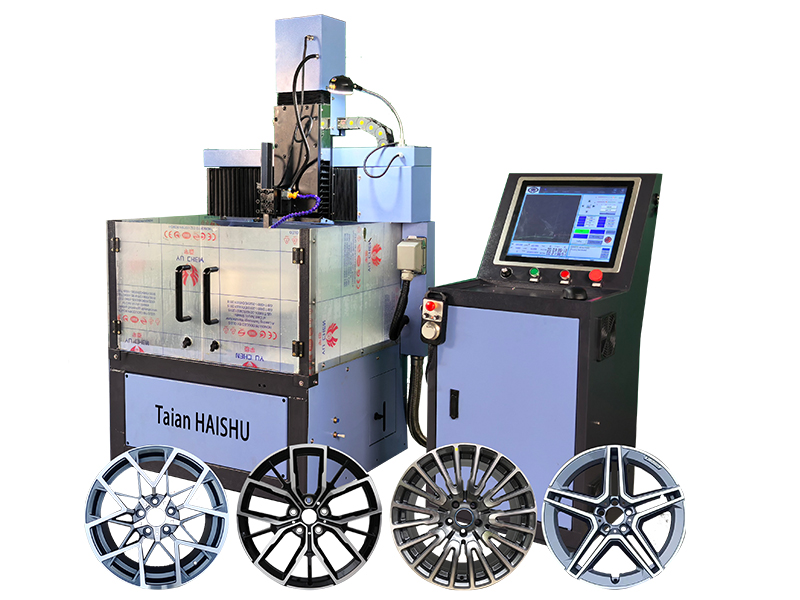
Taian HAISHU builds wheel-specific equipment rather than a general lathe with a wheel fixture added later. The range covers alloy wheel repair refinishing machines and a separate wheel straightening line. For a shop or an investor who wants both face work and bend correction without jumping between unrelated suppliers, that split is practical. The prices sit in a band many independent bays can actually fund, which is the main commercial point, not a claim that every model beats every specialist on every single feature.
3.1 Where the range fits
The company uses a self-developed wheel repair system across the wheel repair machine series, with a 17-inch touchscreen rather than a tiny panel borrowed from another control. The interface is built as dedicated pages, so clamping, detection, tool setting, and cutting are not buried in a generic menu. Parameters can be adjusted around how a shop actually works. Language can be customized across more than 130 options, and a customer logo can sit in the system. The machine nameplate can be customized as well. For a distributor or a multi-site operator, that is more useful than it sounds. Technicians train on a screen they can read, and the machine does not look like an anonymous import on the shop floor.
Wi-Fi, online upgrades, lifetime free software upgrades, and remote service are part of the support story. Software functions for the detection methods are not sold as a later unlock. Laser detection is standard. Probe and tool-tip detection are optional hardware; the software side is included. That is a cleaner commercial structure than a control that looks complete until the first odd wheel.
3.2 Alloy wheel repair refinishing machines
The refinishing line is the core of the alloy wheel repair equipment offer. These are the models buyers should compare when the paid work is diamond cutting, face restoration, and, on the vertical machines, spoke and rim repair.
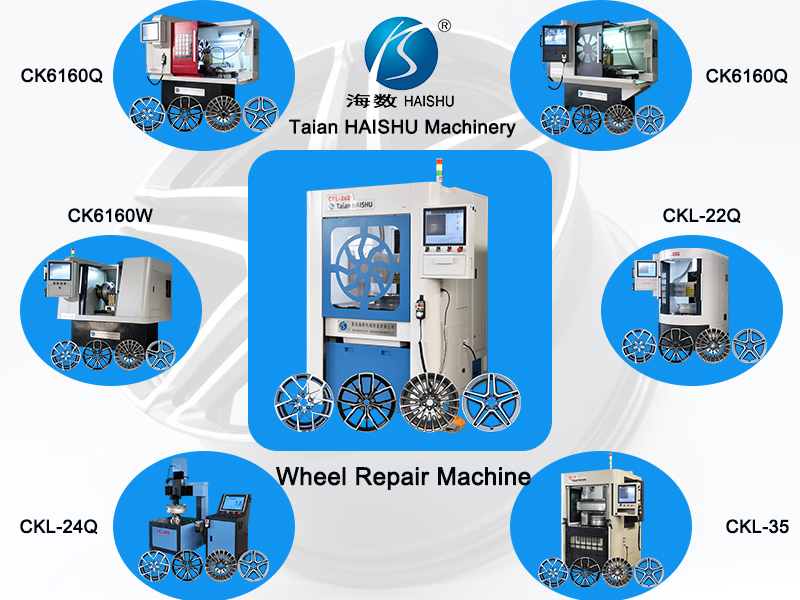
CK6160Q. This is the horizontal wheel hub repair machine in the range. It repairs wheels up to 24 inches, and the size can be discussed when a shop has a clear extended need. The standard main motor is 4 kW, with servo motors of 4N on X and 6N on Z. Typical pricing is USD 5,000–7,000. It suits a buyer who wants a horizontal alloy wheel lathe for everyday car wheels and does not need a portable frame. It is a refinishing machine, not a straightener.
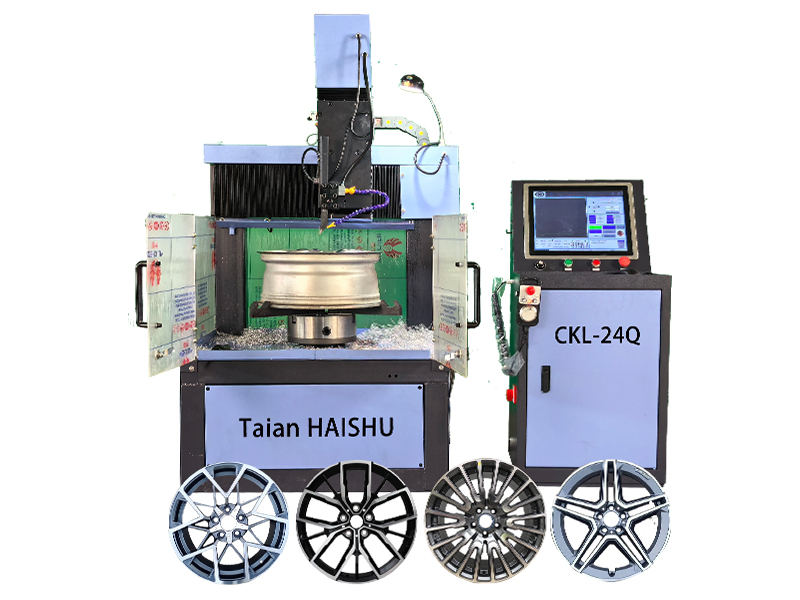
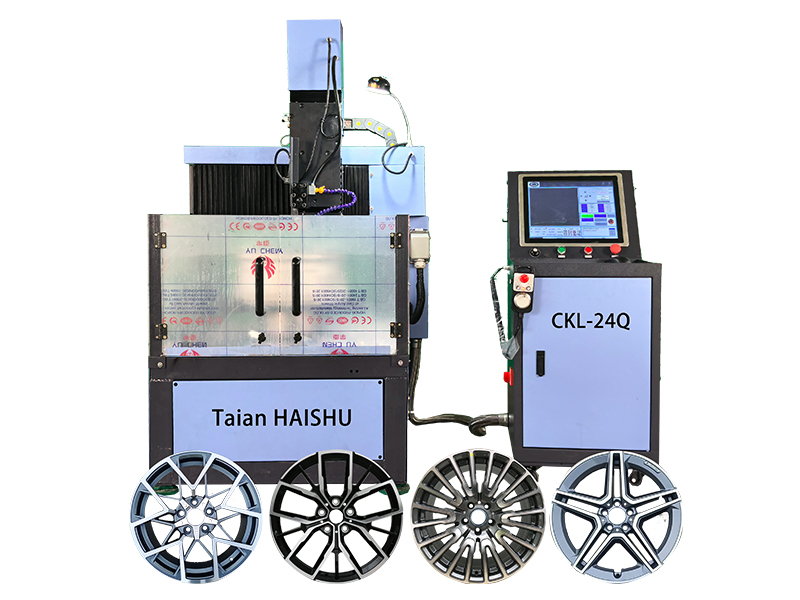
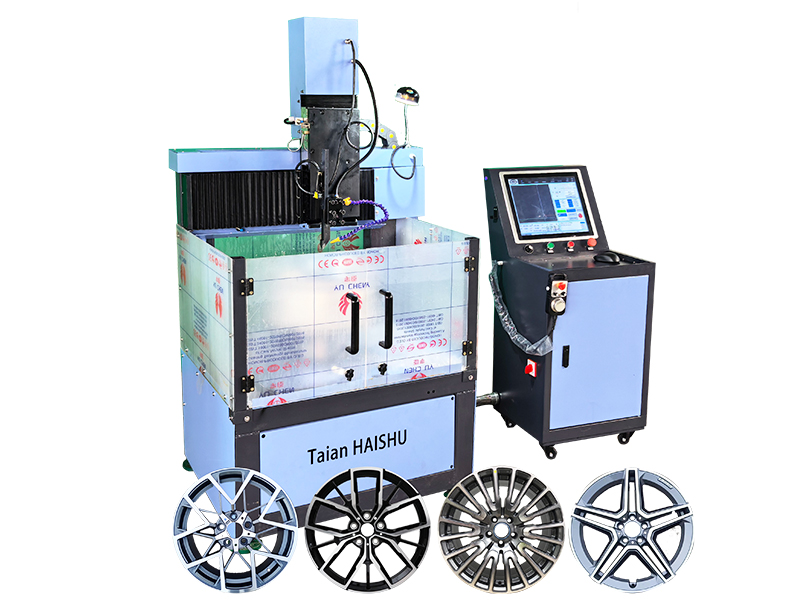
CKL-24Q. This is the portable vertical wheel hub repair machine, and it is the model to look at for mobile wheel repair. It runs the independent wheel repair system on a 17-inch multilingual touchscreen, with laser, probe, and cutter-tip detection. One-touch tool setting, optimization, and program output are built in. Capacity is up to 24 inches. Voltage covers 110V to 440V, which matters if the same machine design has to land in more than one country. The split portable design uses casters and stays at or under 500 kg. Safety doors, automatic lubrication, and optional video recording are part of the specification. Diamond tools are the cutting method. Custom programs and logo branding are available. Pricing is USD 4,500–5,500. For a first van or a tight bay, this is the configuration that matches the job, provided the 24-inch limit matches the work.
CKL-22Q. This is an upgraded vertical wheel hub repair lathe, with a repair range up to 24 inches or 26 inches depending on the build. Motor power is 4 kW, and the servo motors are 6N and 15N. The point of the upgrade is machining rigidity and a fully enclosed design. Pricing is USD 6,000–8,000. Choose it over the lightest portable model when the wheel will stay in one workshop and the operator wants a stiffer cut more than a van-friendly weight.
CKL-26Q. This is one of the more cost-effective vertical wheel hub repair machines in the line, with capacity up to 26 inches. Door choices are pneumatic upgraded doors or switch-style sliding doors, so the enclosure can follow the bay rather than the other way around. Pricing is USD 7,000–9,000. For many independent shops, this is the sensible production step: larger than a basic 24-inch portable unit, without moving into gantry territory.
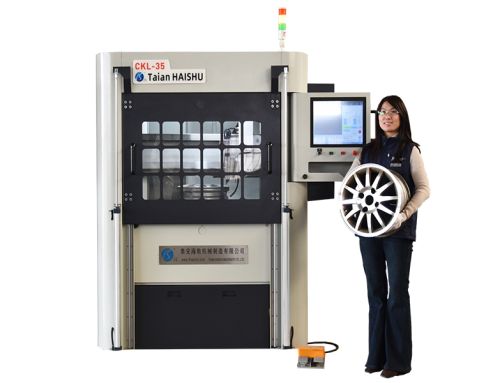
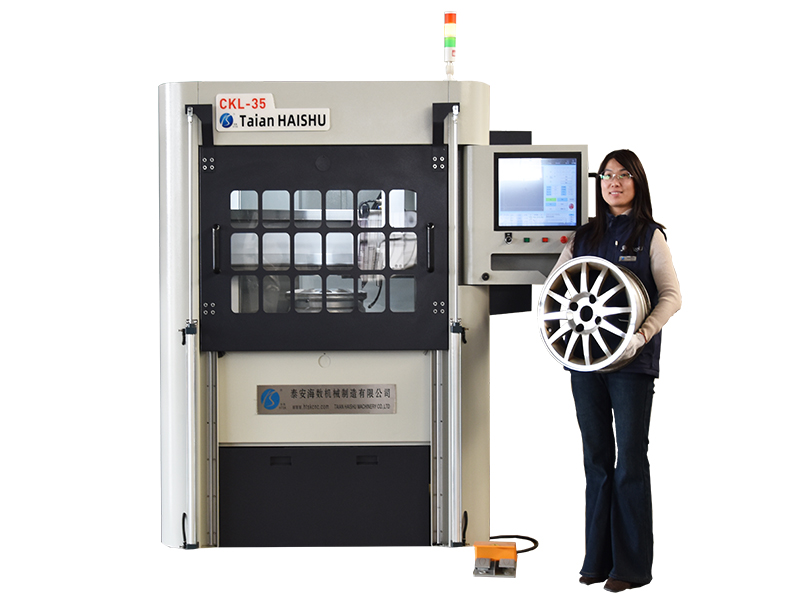
CKL-35. This is the largest wheel hub repair machine in the standard refinishing range, at up to 35 inches. The structure is a double-column, gantry-style design. Three servo motors are used, and all three axes use a 6N design. Chuck options are 250 mm or 320 mm. Pricing is USD 8,000–12,000. It is the alloy wheel CNC machine to specify when oversized wheels are a real share of turnover, not a once-a-year favor.
CKL-35P. This is the upgraded custom version of the CKL-35, sold as the Pro or Plus build. Z-axis travel is 900 mm, and it can repair wheel hubs up to 550 mm in height, still at a maximum wheel size of 35 inches. The standard chuck is an enlarged 320 mm three-jaw, with four-jaw or six-jaw available. Motor power is 5.5 kW. Machine weight is 1.6 tons. Pricing is USD 9,000–14,000. The extra travel and chuck choice are the reason to pay above a standard CKL-35. If the wheels are wide or tall, that money is doing work. If they are not, the standard 35-inch machine is enough.
Vertical models in this refinishing group support both wheel spoke repair and wheel rim repair. That is the practical reason many shops prefer them once the work moves past a simple outer face.
3.3 Wheel straightening equipment
Straightening sits in its own lineup. Treating it as a side function of the lathe would be the wrong read.
RSM595. This wheel straightening machine takes a maximum wheel size of 26 inches and a hydraulic press force of 10 tons. It can also cut the solder joint of car alloy wheels, which is a specific repair step, not a substitute for diamond-cut face work. Pricing is USD 1,000–1,800. As wheel straightening equipment for a tire shop or a body shop that already owns a lathe, the outlay is small relative to the jobs it can take in. It is an automatic hydraulic machine in this lineup.
RSM585. This is the manual hydraulic version in the same special wheel straightening machine lineup. It is the lower-complexity choice when the operator wants direct hydraulic control and the volume does not justify stepping up inside the straightening range. Confirm the exact fixture set for the wheels you see most often before you treat the two models as interchangeable.
A shop that sells both face restoration and bend correction should price the pair, not the lathe alone. An RSM595 next to a CKL-24Q or CKL-26Q is a coherent package. A 35-inch lathe with no straightener still sends bent wheels back out the door.
3.4 System, detection, and daily use
Day-to-day use is where the dedicated system shows its value. Three detection methods are available: laser, probe, and tool tip. Curve optimization runs online in automatic and manual modes. Coordinates can be changed in real time. Machining depth and path can be adjusted while the operator is watching the wheel, including segmented curve repair that leaves a fine chip instead of a heavy scrape.
Tool setting and program output can be done in one step. Path optimization is available manually and automatically. A handwheel unit is there for operators who want a physical feel during setup. The screen layout is a simplified one-stop interface, with customizable wheel model settings and parameters that can follow user habits. Electronic and video tutorials sit alongside the machine. The design target is that a technician without prior CNC experience can learn basic operation in about 30 minutes. That is a fair claim for the first safe cycle on a dedicated page layout. It is not a claim that every difficult wheel becomes easy on the first afternoon. Edge cases still need the tutorials and, if required, remote service.
For distributors, the same system can carry the customer’s logo and a local language. Lifetime free software upgrades reduce the chance that a three-year-old machine is stuck on the version it shipped with.
3.5 Build, options, and a fair read on the brand
The machines use a cast iron base for rigidity and high-precision servo motors so position data stays stable. Clamping uses an extended jaw design so everyday wheels go on faster. Three-jaw, four-jaw, and six-jaw chucks are supported, and self-designed extended fixtures cover different inspection needs. A complete accessory set is part of the supply, which is the right question to confirm on the order, not after delivery.
Tool holding can be a gang tool holder, a manual four-station turret, or an electric four-station turret. For most wheel repair, the gang holder is the sensible recommendation. The job usually needs one diamond tool. Skipping turret indexing removes a failure point, simplifies maintenance, and keeps replacement cost down. A turret is available when a shop has a real reason to index more than one tool. It should not be the default just because it sounds more industrial.
Voltage can be built for 110V, 220V, 380V, or 415V. Appearance, including shape and color, can be customized. That matters more to a branded chain or an importer than to a single-bay shop, but it is a real option rather than a paint conversation after the machine is finished.
The fair limit is also clear. Taian HAISHU is not the only serious name in diamond cutting or straightening. A buyer who wants a British single-phase van lathe with tyre-on cutting, or a European digital straightener with local joystick service, should look at those specialists on their own terms. What HAISHU offers, at USD 4,500–14,000 for the refinishing models listed here and well under USD 2,000 for the RSM595, is a wheel-specific control, broad size coverage, and room in the budget to own both a lathe and a hydraulic wheel straightener. For a large share of independent shops and new wheel-repair investors, that combination is the stronger commercial fit.
4. Seven Other Wheel Repair Machine Brands
These seven are established names outside that lineup. Each has a clear strength. None of them is a copy of the others, and none should be forced into a job it was not built for.
4.1 DCR Systems
DCR Systems, in Britain, builds the DCR Pro as a purpose-designed alloy wheel diamond cutting machine for workshop and mobile use. It cuts from 14 to 24 inches with the tyre on, and up to 30 inches with the tyre off. Published figures put the machine at about 395 kg, roughly 1004 mm wide, 1760 mm high, and 840 mm deep, on a 240V 13-amp single-phase supply. Laser profiling of a typical 20-inch wheel is described as taking about 30 seconds, followed by a short guided cut sequence on a touchscreen.
Main advantages: true van-friendly power and weight, tyre-on diamond cutting up to 24 inches, a very small footprint, and a wider prepare-and-paint equipment family around the lathe. UK list pricing has been quoted near £35,000, so this is a premium mobile refinishing buy, not a budget workshop lathe. Choose it when single-phase mobility and tyre-on face work are the whole business case.
4.2 Wheel Restore
Wheel Restore, from HBC Systems in Denmark, is a wheel restore machine maker in the strict sense. The WR-DCM3 diamond-cut lathe is built to refinish wheels up to 30 inches, with automated laser probing, a touchscreen, stored wheel profiles, and the ability to work with the tyre on or off. Company material puts the lathe near 450 kg. The WM-300 electro-hydraulic straightener covers about 10 to 26 inches and weighs about 325 kg, with adjustable hydraulic pressure. The same group also supplies blasting and coating equipment, so a shop can buy a restoration line rather than one machine.
Main advantages: Danish restoration software, tyre-on cutting, a wheel library, CE-oriented workshop design, and a matched path from cleaning through straightening, cutting, and finish. Buyers comparing wheel restore machine price should expect a premium European package. The advantage is the workflow, not a low entry ticket.
4.3 Lehigh
Lehigh is a long-standing name in North American alloy wheel repair, especially among shops that diamond-cut faces all day. The MR-2540 is specified for refinishing up to 21 inches, the MR-2940 up to 25 inches, and a larger model up to 30 inches. The machines use probe digitizing, a touchscreen conversational control, handwheels, a Meehanite cast structure, and an enclosed slide-door design. Digitizing is typically described in the 5-to-10-minute range, with a fast cutting pass once the path is set.
Main advantages: a proven production record in U.S. and Canadian rim shops, probe-based profile capture, manual handwheel backup, and a clear step-up in diameter across models. It is a workshop wheel refinishing machine, not a 400 kg van unit. Shops that already know the brand, and that want local familiarity in North America, have a concrete reason to stay with it.
4.4 Mint Alloys
Mint Alloys supplies the Tryax alloy wheel lathe range in the UK and wider European market, including static and mobile diamond-cut machines. The TY30-VS uses a ribbed cast-iron frame and a linear-rail cross slide. It is a compact vertical-style lathe rated to cut wheels from 14 to 30 inches, which covers most retail work and a useful share of larger rims without a full gantry machine.
Main advantages: a cast-iron structure aimed at a stable cut, 30-inch capacity in a space-saving frame, and a product line already aimed at shops opening a diamond-cut service. It is alloy wheel refurbishment equipment for face machining, with demonstration support in its home market. Confirm current power and training terms locally; do not assume it replaces a separate rim straightening machine.
4.5 Comec
Comec, in Porcia, Italy, has built automotive machine tools since 1961, including engine and brake equipment as well as rim work. The RSM240 is a rim straightening machine and lathe for alloy, aluminum, and steel wheels. The specification table lists an application range of 13 to 24 inches, maximum punch force of 3,950 kg, a 0.75 kW hydraulic unit, a separate 0.75 kW lathe unit, and a weight of 350 kg. Pressure is set through a gauge so the push can be matched to the material. A set of punches, tips, and centering rings comes with the machine, and the lathe unit is there to clean remaining edge damage after straightening.
Main advantages: a compact Italian workshop press with regulated force, an integrated edge lathe, and a brand many garages already trust for other machines. It is rim repair equipment for correction and edge cleanup. It is not an alloy wheel diamond cutting machine for full face restoration.
4.6 Atek Makina
Atek Makina, in Turkey, focuses on professional wheel straightening rather than CNC face cutting. The Pangea covers alloy and steel wheels from 12 to 28 inches, with digital measurement in the horizontal and vertical directions, joystick control, a folding and sliding lathe, a 1.5 kW hydraulic motor, and a weight of about 940 kg. Rotation is variable, roughly 5 to 98 rpm. The Digital 5600, in UK dealer listings, covers about 10 to 26 inches, can push and pull, and is specified with fine adjustment around 0.1 mm. UK retail examples have been listed near £12,440 for the Digital 5600 and £17,670 for the Pangea, before tax and installation.
Main advantages: digital bend indication, joystick control, wide diameter on the Pangea, two-arm correction on the higher model, and a push-and-pull piston on the Digital series. This is the hydraulic wheel straightener to shortlist when bent rims are the product and a basic edge lathe is enough. It is a different budget and a different job from a USD 5,000 face lathe.
4.7 GAHO
GAHO, in Brazil, has spent decades on alignment and wheel-service tools and exports the GH-720 wheel straightener to a long list of countries. The machine straightens steel and alloy wheels from 13 to 24 inches with a dedicated hydraulic piston and interchangeable tips, rather than asking a shop to improvise on a general press. It is aimed at alignment and tire businesses that want a rim fixing machine without taking on a CNC lathe.
Main advantages: a patented hydraulic layout, a clear 13-to-24-inch working range, and a simpler operating idea for shops whose paid work is bend correction. It will not replace an alloy wheel lathe. For an alignment shop adding wheel rim repair machine services, that narrower focus is the advantage.
5. Compare Capacity, Job Type, and Budget
A short table is more useful than a longer slogan. Prices move with options, shipping, and local tax. Treat the figures below as published or commonly quoted bands, and confirm the current build before you order.
5.1 Brand snapshot
| Brand | Primary job | Capacity to check | Commercial position |
| Taian HAISHU | Diamond-cut refinishing and separate hydraulic straightening | 24–35 in on lathes; 26 in on RSM595 | Workshop and mobile; USD 4,500–14,000 lathes, straightener under USD 2,000 |
| DCR Systems | Mobile and workshop diamond cutting, tyre-on | 24 in tyre-on; 30 in tyre-off | Premium UK-built van lathe; about 395 kg; single-phase |
| Wheel Restore | Diamond cutting plus straightener and finish line | Up to 30 in cut; about 10–26 in straighten | Danish workflow package; premium wheel restore machine price |
| Lehigh | Production diamond-cut CNC lathes | 21 in, 25 in, and up to 30 in by model | Established North American workshop lathes |
| Mint Alloys | Diamond-cut alloy wheel lathe | 14–30 in on TY30-VS | European static and mobile face-cutting range |
| Comec | Hydraulic straightening with edge lathe | 13–24 in; 3,950 kg punch; 350 kg | Compact Italian garage press |
| Atek Makina | Digital hydraulic straightening with basic lathe | 12–28 in Pangea; about 10–26 in Digital | Higher-priced dedicated straightener |
| GAHO | Hydraulic rim straightening | 13–24 in | Alignment-shop straightener, not a CNC lathe |
5.2 Taian HAISHU model snapshot
| Model | Type | Max wheel | Price (USD) | Spec worth checking |
| CK6160Q | Horizontal refinishing | 24 in, extendable by agreement | 5,000–7,000 | 4 kW main motor; X/Z servos 4N/6N |
| CKL-24Q | Portable vertical refinishing | 24 in | 4,500–5,500 | ≤500 kg; 110–440V; mobile split design |
| CKL-22Q | Upgraded vertical lathe | 24 or 26 in | 6,000–8,000 | 4 kW; servos 6N/15N; fully enclosed |
| CKL-26Q | Vertical refinishing | 26 in | 7,000–9,000 | Pneumatic or sliding doors |
| CKL-35 | Gantry refinishing | 35 in | 8,000–12,000 | Three 6N axes; 250 or 320 mm chuck |
| CKL-35P | Custom 35 in upgrade | 35 in; hub height to 550 mm | 9,000–14,000 | 900 mm Z; 5.5 kW; 1.6 t; 320 mm chuck |
| RSM595 | Automatic hydraulic straightener | 26 in | 1,000–1,800 | 10-ton press; solder-joint cutting |
| RSM585 | Manual hydraulic straightener | Confirm on the quoted build | Ask for the current quote | Direct hydraulic control |
5.3 A simple payback check
Use your own labor rate and ticket price. The figures here are only a planning example.
Assume a face repair billed at USD 120, with USD 25 in consumables and USD 30 of loaded operator time, leaving USD 65 contribution per wheel. Four paid wheels a day, 20 days a month, is 80 wheels and about USD 5,200 contribution before rent and overhead. A CKL-26Q at the middle of its USD 7,000–9,000 band is then a short payback if that volume is real. If the shop only has one paid diamond-cut wheel a day, the same machine takes far longer, and a CKL-24Q or CK6160Q may fit the risk better.
Straightening math is simpler. At USD 1,000–1,800, an RSM595 is covered by a modest run of bend repairs even at USD 70 to USD 100 a wheel, after the wheels that should not be repaired have been turned away. Do not use either example as a forecast. Use it to test whether the volume you already see can carry the machine you want.
6. Match the Machine to the Business
6.1 Mobile and first-machine buyers
A mobile operator needs weight, voltage, and a control that a second technician can learn without a week of programming. The CKL-24Q is built for that: under 500 kg, multi-voltage, a 17-inch wheel-specific screen, and 24-inch capacity. DCR Pro is the alternative when the route is single-phase, the wheels can stay on the tyre up to 24 inches, and the budget can carry a premium British lathe. Mint Alloys is worth a demonstration if the buyer is already in that European supply chain and wants up to 30 inches in a compact diamond-cut lathe.
Add a small straightener only if the van or the partner shop will actually do bends. A face lathe does not fix a flat spot.
6.2 Busy workshops and larger wheels
A fixed bay that lives on 18-to-26-inch diamond-cut work should look hard at the CKL-26Q, and at the CKL-22Q if enclosure and rigidity matter more than the last two inches. The CK6160Q remains a sound horizontal choice up to 24 inches when the team prefers that layout and the price needs to stay in the USD 5,000–7,000 band.
Once 30-inch-class and tall hubs show up every week, the CKL-35 or CKL-35P is the honest specification. Lehigh’s larger models and the Wheel Restore WR-DCM3 are the comparisons to make if the shop wants a North American production lathe or a Danish tyre-on system and is ready for that price level. Buying a 24-inch portable machine and hoping it will “mostly” do 35-inch work is how a shop creates a second purchase.
6.3 Shops that mainly straighten rims
If the board outside says alignment, and the complaint is a bend after a pothole, start with a wheel rim straightening machine. The RSM595 is the low-cost automatic hydraulic option to 26 inches and 10 tons, with solder-joint cutting as a stated function. The RSM585 is the manual counterpart. Comec’s RSM240 is the compact European press-and-edge-lathe for 13 to 24 inches. Atek is the step up when the shop wants digital measurement, joystick control, and, on the Pangea, coverage to 28 inches. GAHO’s GH-720 is the straightforward 13-to-24-inch hydraulic option for shops that do not want a CNC conversation at all.
An alloy wheel straightening machine and an alloy wheel repair machine are complementary. They are not substitutes.
7. Mistakes That Waste Money
7.1 Capacity and layout errors
The expensive mistake is not always the expensive machine. It is a 24-inch lathe in a city full of 26-inch SUV wheels, or a 1.6-ton gantry in a rented bay with a standard doorway and no prepared base. It is also a vertical machine bought for spoke work when the operator only ever cuts an outer lip, or a horizontal machine bought because it was familiar when the shop needed spoke access.
Measure twenty recent wheels. Note diameter, width, and whether the damage was on the face, the spoke, or the bead. Buy the machine that covers that list, plus a small margin. Do not buy the machine that covers a photo on a supplier’s wall.
7.2 Software, voltage, and support gaps
A control that only one person understands becomes a bottleneck the week that person is off. Ask for the language you will actually train in. Ask whether detection software is included. Ask how a path is corrected while the wheel is on the machine. Ask what happens to software two years from now, and whether someone can log in remotely.
Voltage mistakes are quieter and just as costly. A 380V machine on a 220V shop, or a three-phase lathe promised for a domestic van socket, stops the project before the first chip. CKL-24Q’s 110V–440V range and the wider 110/220/380/415V build options exist so this can be settled on the order. Use them.
Leaving chucks, diamond tools, and fixtures out of the comparison also skews the price. A complete accessory set and a gang tool holder, where one tool is enough, usually cost less to own than a turret the shop never indexes.
8. How to Move From Shortlist to Order
8.1 Questions worth asking every supplier
Put the same questions to every quote, including Taian HAISHU and the seven brands above.
- What is the real maximum diameter, width, and, if relevant, hub height on the exact build?
- Is the machine a refinishing lathe, a straightener, or both? If both, which unit does which job?
- Which detection method is standard, and what does the optional probe or tool-tip kit cost?
- Can the operator change depth and path while watching the cut?
- What voltage will this unit be built for, and what does it draw?
- What is the shipping weight, and can it pass the door?
- Which chuck, jaws, tools, and fixtures are in the price?
- What language is on the screen, and can a logo or nameplate be set before shipment?
- Who trains the operator, and who answers after installation?
- Which wheels should this machine refuse?
A supplier who can answer those without sliding into a different model is a supplier you can order from.
8.2 A practical way to choose
For a first professional wheel repair setup, a dedicated refinishing machine plus a separate straightener covers more real tickets than one oversized compromise. On the Taian HAISHU list, that often means a CKL-24Q or CK6160Q where 24 inches and budget come first, a CKL-22Q or CKL-26Q where the bay is fixed and the wheels run larger, and a CKL-35 or CKL-35P only when the diameter and hub height are already in the order book. Pair the lathe with an RSM595, or the manual RSM585 if hands-on hydraulic control is preferred.
Use DCR Systems, Wheel Restore, Lehigh, or Mint Alloys when a specific diamond-cut workflow, a home-market service channel, or tyre-on cutting is worth the higher refinishing spend. Use Comec, Atek Makina, or GAHO when the business is straightening and the lathe, if any, is only an edge tool.
If the shortlist is still open, ask Taian HAISHU for a configured quote: wheel sizes, voltage, chuck, door style, language, and whether the order is a lathe, a straightener, or both. The same request, sent to the other brands that match the job, will show the real difference faster than another brochure. Buy the machine that fits the wheels you already see, the power you already have, and the person who will run it on a Tuesday afternoon. That is the choice that gets used, and the only one that pays the invoice back.